HR AI is moving from answering questions to running the workflow
50skills has raised $6 million after customers automated millions of people-process actions. The more interesting story is what happens when AI stops assisting HR and starts executing the work.
For most HR teams, the first wave of generative AI has been fairly recognisable: draft this job description, summarise these comments, write this email, answer this employee question.
The next wave looks different.
Instead of helping an HR professional complete a task, AI is increasingly being inserted into the process itself: checking information, interpreting documents, routing requests and triggering the next action without somebody in HR manually moving the work along.
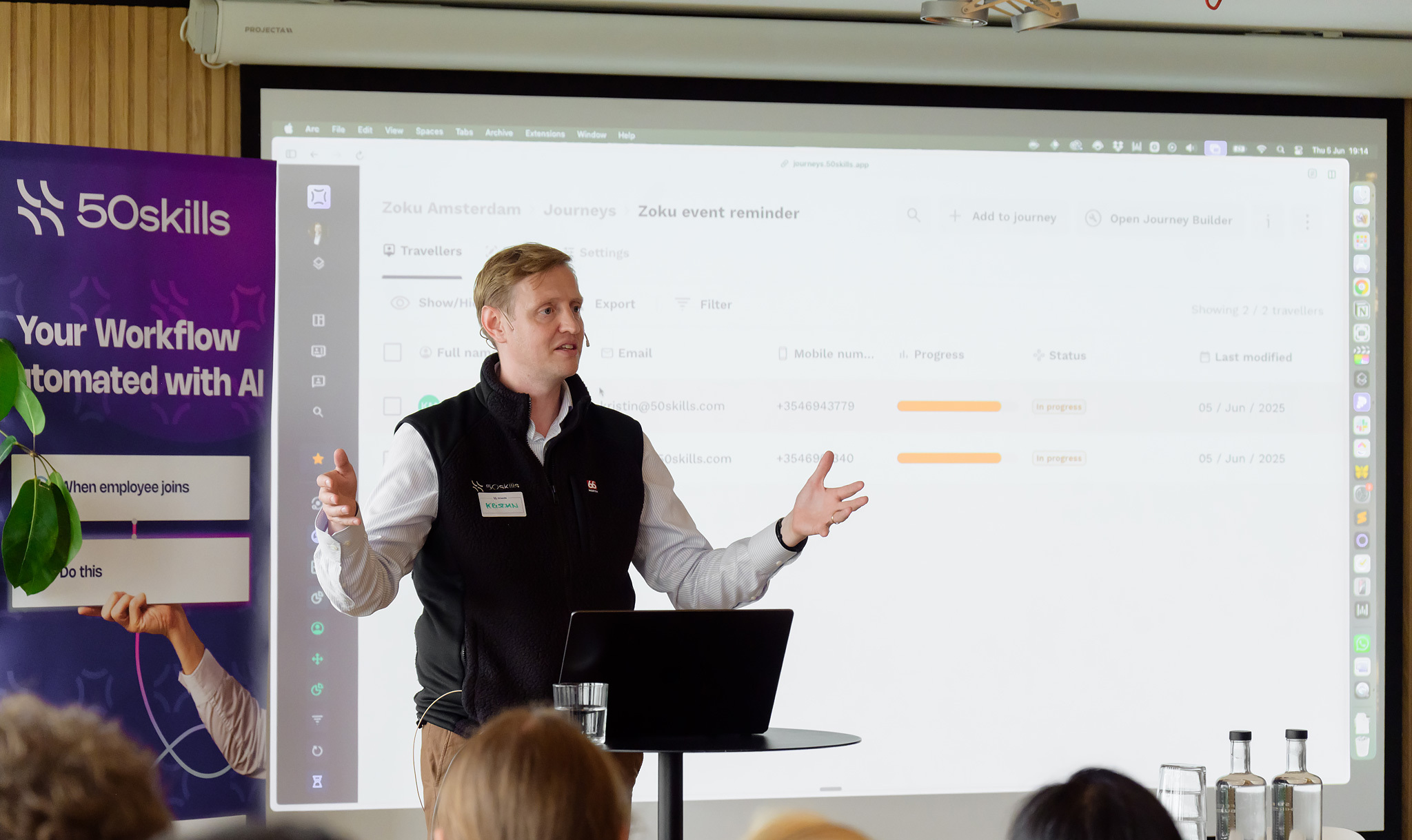
That is the proposition behind Icelandic HR technology company 50skills, which has raised $6 million to expand its people-workflow platform.
The funding round was co-led by Frumtak Ventures, Swiss Post Ventures, Avant and US family office DRD Investments. The company says the investment will fund sales and marketing expansion alongside further development of its AI agents.
But the funding is less interesting than what some of its customers are already using the technology to do.
From AI assistant to AI operator
50skills allows an HR team to describe a process in plain language and turn it into a workflow connected to existing business systems.
Some stages are conventional automation: if X happens, do Y.
Others can be handed to an AI agent where interpretation is required. Human judgement can then be retained for decisions that an organisation does not want the system making independently.
That distinction matters.
At Icelandair, for example, more than 3,000 employee health-grant receipts each year can now be checked by AI against company policy, categorised where necessary and passed towards payroll, with HR retaining final review.
The airline has now digitised more than 20 HR workflows using 50skills and reports removing the equivalent of four to five months of manual administration each year.
Air Atlanta says automating one visa-processing workflow saves around 50 hours each week. Hotel group Íslandshótel reports reducing the time spent processing employee benefit applications by 80%.
These figures come from 50skills’ own published customer case studies, so they should be treated as reported customer outcomes rather than independent evaluations. But they illustrate an important change in where HR technology is heading.
The question is no longer simply: what can AI generate?
It is becoming: what work are we prepared to let it perform?
That creates a different governance problem
This distinction becomes particularly important in HR because seemingly administrative actions can affect somebody’s pay, employment, access or career.
A chatbot drafting an answer is relatively easy to review before anything happens.
An agent checking a document, updating a system or advancing an employee through a process is taking an action.
That makes the boundary between automation, AI interpretation and human judgement part of the operating model rather than simply a technology configuration.
50skills CEO Kristján Freyr Kristjánsson describes the challenge as balancing predictable workflows with AI agents where interpretation is needed, while retaining human oversight.
“For HR and people operators that balance is not optional, it is the job,” he said.
It is a useful distinction as AI adoption inside HR accelerates.
SHRM’s 2026 research, based on 1,908 HR professionals, found that 39% of organisations had already implemented AI within HR, with another 7% planning to do so during the year. Yet 56% of HR functions using AI did not formally measure the success of those investments.
That gap could become harder to ignore as AI moves from producing content into executing processes.
Start with the workflow, not the agent
There is also something decidedly unglamorous about the strongest examples here.
They are not AI avatars, employee sentiment engines or digital colleagues holding strategic conversations.
They are receipts. Visas. Onboarding forms. Approvals. Contracts. Background checks.
That may be precisely where the more useful HR AI story is developing.
Deloitte estimates HR teams can spend as much as 57% of their time on administrative work. If AI can remove parts of that workload, the value will not come from adding another AI interface for employees to learn. It will come from taking steps out of processes employees and HR teams already have to navigate.
For HR leaders, that changes the starting question.
Rather than asking where to “use AI”, look at the processes consuming disproportionate amounts of time. Work out which steps must always follow fixed rules, which genuinely require interpretation and which decisions should remain human.
The technology is getting increasingly capable of handling all three.
Deciding where it should stop is still HR’s job.
That also links to a wider workforce challenge. As EmEx has explored in its coverage of AI upskilling and workforce strategy, buying AI tools is not the same as redesigning work around them.
About 50skills
50skills is an Icelandic HR technology company headquartered in Reykjavík, with an office in Stockholm and customers across the Nordics and UK. Its products include the Hire applicant tracking system and Journeys, a platform for building and running automated people workflows
Related Articles
-
HeadFirst Global becomes Vertage – but the bigger shift is from headcount to outcomes
The EUR10 billion workforce group is uniting 11 operating businesses under one brand and platform. Its more ambitious bet is that companies will increasingly define the work they need done first, then use a mix of specialist talent and AI agents to deliver it.
2–4 minutes -

Why lone working is one of the workplaces biggest safety blind spots, says safety expert
One of the most overlooked health and safety issues in workplaces is lone working, according to leading workplace health and safety expert, Brenig Moore. Across offices, schools, public buildings, shared spaces, and retail sites, many people are often asked to work before and after opening times, or at unsociable hours when nobody is around. That…
3–4 minutes -
How to keep a flexible frontline workforce connected and engaged
Frontline workforce models now have to be more flexible than ever, with employers looking to optimise their use of full-time, temporary and seasonal staff whose schedules can vary significantly from week to week. On the one hand, this is ideal for organisations that need to adapt to changing demand, often at short notice and particularly in sectors…
4–6 minutes
Most Read
Get it in your inbox
The EMEX weekly newsletter — insight for HR leaders every Thursday.
Advertisement