Holiday Pay Calculator UK: Fixed Hours, Variable Pay, Rolled-Up and Leavers
This holiday pay calculator works out what a worker should be paid for statutory holiday in Great Britain, using the methods in GOV.UK and Acas guidance, and shows the working.
This is general information for Great Britain and is not legal, tax or financial advice. It covers statutory holiday. A contract can give more. Sources: GOV.UK on holiday pay and Acas on calculating holiday pay.
How is holiday pay calculated?
Workers get a week’s pay for each week of statutory holiday they take. Almost all workers are entitled to 5.6 weeks a year. What counts as a week’s pay depends on the working pattern.
Fixed hours and fixed pay
A week’s holiday pay is the worker’s normal pay for a week, whether they are full time or part time. Acas gives the example of someone who works 37 hours and earns £500 a week: a week’s holiday must be paid at £500. This holiday pay calculator divides the week’s pay by the days worked a week to give a day’s holiday pay. For monthly pay it multiplies by 12 and divides by 52 to get a week’s pay.
Variable pay and the 52 week holiday pay reference period
Where pay changes from week to week, a week’s holiday pay is the average pay over the previous 52 weeks in which the worker was paid. Weeks with no pay are left out and earlier weeks are used in their place. An employer can look back no more than 104 weeks. If there are fewer than 52 paid weeks in that time, the average is taken over the paid weeks there are. GOV.UK guidance also says to leave out any week in which the worker was on sick leave or statutory leave such as maternity leave, so enter 0 for those weeks.
What counts as normal pay
At least 4 weeks of the 5.6 weeks must be paid at the worker’s normal rate. That includes commission, regular overtime, and payments linked to length of service or professional qualifications. Bonuses are usually not included. The other 1.6 weeks can be paid at the basic rate for workers with regular hours, although many employers pay all 5.6 weeks the same way. For irregular-hours and part-year workers all statutory leave is paid at the normal rate. Include these payments in the figures you enter.
Rolled up holiday pay
Rolled-up holiday pay means the employer adds holiday pay to each pay packet in place of paying it when leave is taken. It is allowed only for irregular-hours workers and part-year workers, in leave years that started on or after 1 April 2024. The rate is 12.07% of total pay in the pay period, and it should be shown as a separate item on the payslip. The 12.07% comes from 5.6 weeks of holiday divided by the other 46.4 weeks of the year. The GOV.UK guidance on the holiday pay reforms works it out in two steps: divide the pay by 100 and round to the nearest penny, then multiply by 12.07 and round again. This calculator follows those steps.
Holiday pay when someone leaves
An employer must pay for statutory holiday that a worker has built up and not taken by their last day. This applies even if the worker is dismissed for gross misconduct. The calculator takes the full-year entitlement, multiplies it by the calendar days employed in the leave year divided by the days in that leave year, rounds up to one decimal place, takes off the days already used and pays the rest at a day’s pay. This follows the leaver method in the GOV.UK guidance on calculating holiday entitlement, where a worker on 22.4 days a year who leaves after 116 days of a 366-day leave year has built up 7.1 days. If a worker has taken more leave than they built up, the employer can take the difference from final pay only if this was agreed in writing beforehand. See GOV.UK on taking holiday before leaving a job.
Holiday pay calculator worked example
A worker with no fixed hours was paid these amounts over the last 10 weeks, most recent first: £320, £0, £410, £380, £0, £295, £350, £405, £300 and £340. The two weeks with no pay are skipped. The 8 paid weeks add up to £2,800, so the average week’s pay is £2,800 ÷ 8 = £350.00. That is what they should be paid for a week of holiday. If the same worker were on rolled-up holiday pay and earned £460 in a pay period, the holiday pay added would be £55.52.
To find out how many days or hours of holiday someone is entitled to, use the pro rata holiday calculator in the related tools below.
Questions about holiday pay
How do I calculate holiday pay for one day?
For a worker with fixed hours, divide a week’s pay by the number of days worked a week. For example, someone who earns £500 a week and works 5 days a week gets £100.00 for a day’s holiday and £500.00 for a week’s holiday.
What is the 52 week holiday pay rule?
Where pay varies, a week’s holiday pay is the average of the last 52 weeks in which the worker was paid. Weeks with no pay are skipped and earlier weeks are counted in their place, going back no more than 104 weeks. If there are fewer than 52 paid weeks, the employer uses the paid weeks there are. For example, 8 paid weeks that add up to £2,800 give an average of £350.00 a week.
Does overtime count towards holiday pay?
Regular overtime must be included in holiday pay for at least 4 weeks of the statutory 5.6 weeks. The same applies to commission and to payments linked to length of service or professional qualifications. Bonuses are usually not included. Many employers apply the same rate to all 5.6 weeks.
What is rolled up holiday pay?
Rolled-up holiday pay is holiday pay added to each pay packet in place of pay at the time leave is taken. Employers can use it only for irregular-hours and part-year workers, for leave years that started on or after 1 April 2024. It is 12.07% of total pay in the pay period. On pay of £460 the rolled-up holiday pay is £55.52.
Do I get paid for holiday I have not taken when I leave my job?
Yes. Your employer must pay for statutory holiday you have built up and not taken by your last day, including after a dismissal for gross misconduct. For example, a worker on £500 a week and 28 days a year who leaves on 30 June in a leave year that began on 1 January has built up 13.9 days. If they have taken 8 days, they are owed 5.9 days, which is £590.00.
Is holiday pay taxed?
Yes. Holiday pay is paid through payroll like normal wages, so tax and National Insurance are taken off in the usual way. The figures from this holiday pay calculator are before those deductions.
More from Employee Experience Magazine
Related tools
Weekly newsletter
Research, news and practical ideas for people leaders, sent once a week.
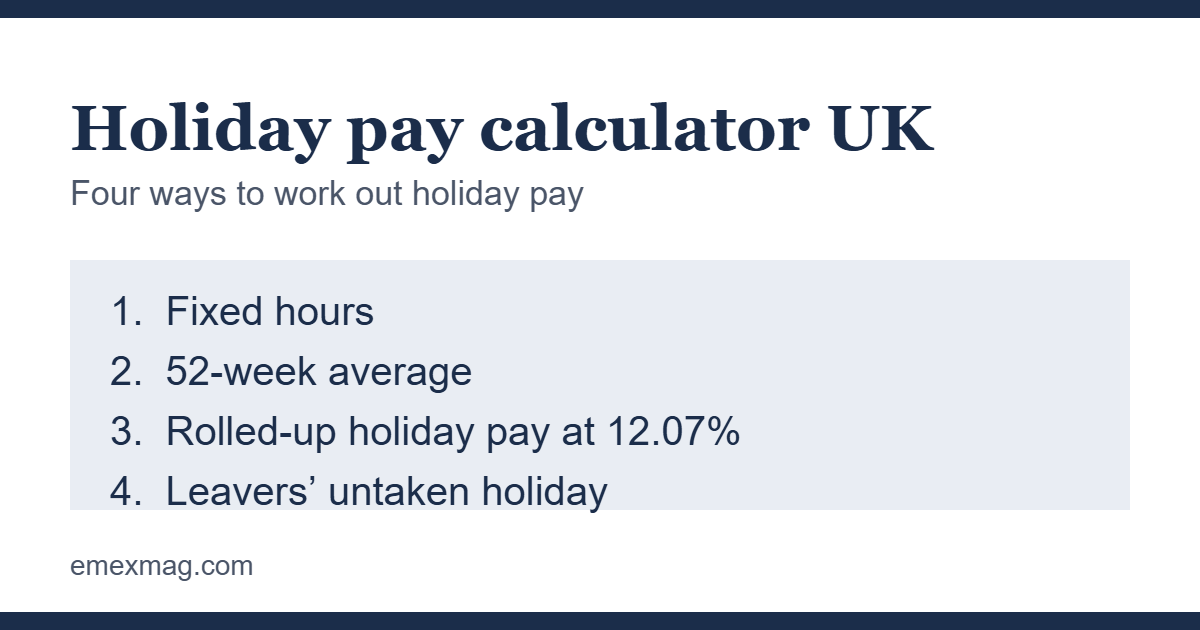
Use this holiday pay calculator for fixed hours, a 52-week average or rolled-up pay. It also works out a leaver’s untaken holiday, and it shows the working.