Pay Raise Calculator: Salary Increase Calculator for Percent and Dollar Raises
This pay raise calculator shows your new pay after a raise, or the percent raise behind a new pay figure, for a salary or an hourly rate. You can use it as a salary increase calculator for a percent raise or a dollar raise. It gives gross pay per year, month, two weeks, week and hour, before and after the raise.
All figures are gross pay. This calculator does not work out federal or state income tax, Social Security, Medicare or any other withholding, so take-home pay will be lower. Nothing you enter leaves this page.
Raise calculator for managers: cost a raise across a team
Apply one percent raise to several salaries and see each new salary and the total cost to your budget.
The total is the rise in gross salaries only. Employer payroll taxes and benefits linked to salary add to the real cost.
How to calculate a pay raise or salary increase
The salary increase calculator above uses three short formulas. You can check any result by hand.
- New pay from a percent raise: new pay = current pay × (1 + percent ÷ 100).
- Percent raise from two pay figures: percent = (new pay − current pay) ÷ current pay × 100.
- Percent raise from a dollar raise: percent = dollar raise ÷ current pay × 100.
To compare pay periods, the calculator first turns your pay into a yearly figure. For an hourly rate, annual pay = hourly rate × hours a week × weeks worked a year. It then divides annual pay by 12 for monthly pay, by 26 for biweekly pay and by 52 for weekly pay. Hourly pay is annual pay divided by the hours you work in a year. If your employer pays twice a month, halve the monthly figure.
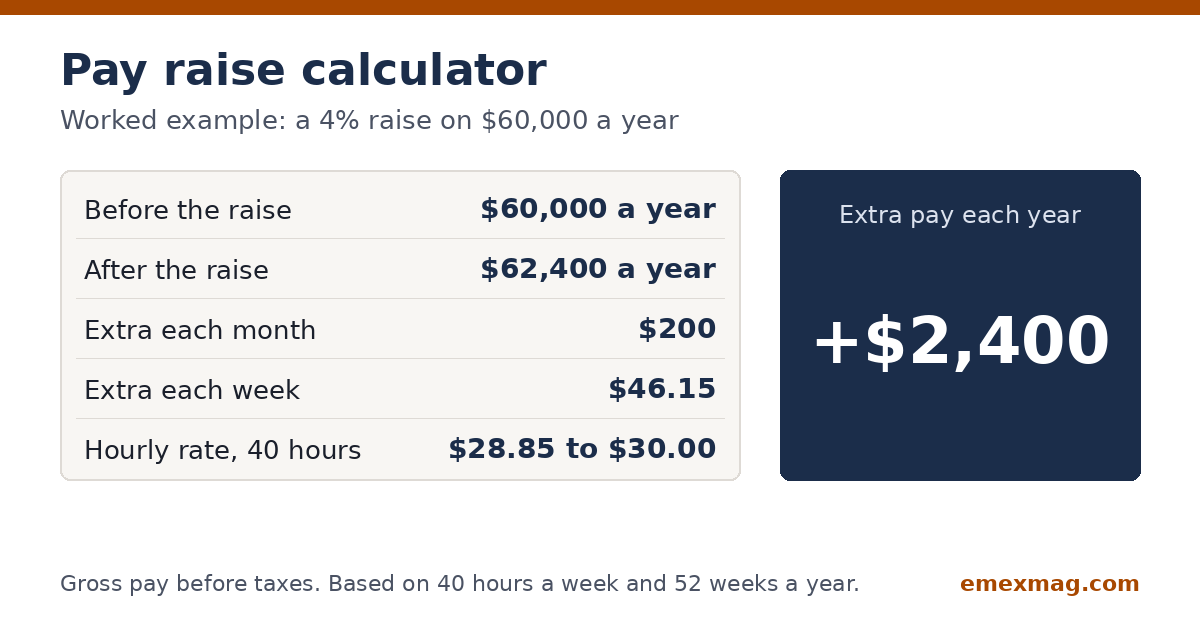
Pay raise calculator worked example: a 4% raise on $60,000
Maria earns $60,000 a year and works 40 hours a week for 52 weeks. She is offered a 4% raise. New pay = $60,000 × 1.04 = $62,400 a year, a raise of $2,400. Monthly gross pay goes from $5,000.00 to $5,200.00. Biweekly gross pay goes from $2,307.69 to $2,400.00. Weekly gross pay goes from $1,153.85 to $1,200.00. Her hourly equivalent goes from $28.85 to $30.00. Enter the same numbers above and the calculator gives the same figures.
If the raise was backdated by 8 weeks, retroactive pay is the weekly difference of $46.15 times 8, which is $369.23 gross.
Hourly raise calculator example
Choose “Hourly rate” to use the tool as an hourly raise calculator. A worker on $20.00 an hour who gets a $1.00 raise moves to $21.00, which is a 5% raise. At 40 hours a week for 52 weeks that is $2,080 more a year before tax, or $40.00 more a week.
Is the raise more than inflation?
A raise lifts what you can buy only if it is larger than the rise in prices over the same period. The calculator works out the real change as (1 + raise) ÷ (1 + inflation) − 1. For example, with a 4% raise and an inflation rate of 3%, the real change is about 0.97%. Inflation changes every month, so the percent raise calculator asks you to enter the rate yourself. The Bureau of Labor Statistics publishes the 12-month change in the Consumer Price Index on its CPI page.
Questions about pay raises
How do I calculate a salary increase percentage?
Subtract your old pay from your new pay, divide the answer by your old pay and multiply by 100. For example, a move from $50,000 to $52,000 is $2,000 divided by $50,000, which is a 4% raise. The pay raise calculator on this page does this in the “Percent raise from old and new pay” mode.
How much is a 3% raise on $50,000?
A 3% raise on $50,000 is $1,500 a year, so the new salary is $51,500. Before tax, that is $125.00 more a month or $57.69 more every two weeks.
How much is a $1 an hour raise worth in a year?
For someone who works 40 hours a week for 52 weeks, a $1 an hour raise adds $2,080 a year before tax. That is 2,080 paid hours times $1. Change the hours and weeks in the calculator if you work a different schedule.
How do I calculate retroactive pay for a raise?
Work out the difference between your new and old gross pay for one pay period, then multiply by the number of periods since the raise took effect. For a raise from $60,000 to $62,400, the weekly difference is $46.15, so 8 weeks of retroactive pay is $369.23 before tax.
Does this calculator show my take-home pay after a raise?
No. It shows gross pay only. It does not calculate federal or state income tax, Social Security, Medicare or other withholding, so the increase in your paycheck will be smaller than the gross figures shown.
How do I know if my raise beats inflation?
Compare your percent raise with the rise in prices over the same period. Check the “Compare the raise with inflation” box and enter the latest 12-month Consumer Price Index change from the Bureau of Labor Statistics. With a 4% raise and 3% inflation, your pay buys about 0.97% more than before.
Related tools
- Overtime calculator: time and a half, double time and regular rate of pay.
- Generation calculator: find a generation by birth year and see your workforce mix.
Use this pay raise calculator to see new pay from a percent raise, in a year, month, week and hour. It also works as a salary increase calculator: it finds the percent behind a new salary or hourly rate, and it shows retro pay and an inflation check.