Overtime Calculator
This overtime calculator works out regular pay, overtime pay and total gross pay for one workweek from an hourly rate and the hours worked. It uses the federal rule of overtime after 40 hours in a workweek, with time and a half as the default.
All figures are gross pay. This calculator does not work out taxes or withholding. It shows federal rules under the Fair Labor Standards Act (FLSA), and state rules can differ. It is general information and not legal advice. Nothing you enter leaves this page.
Regular rate helper: overtime pay calculator for bonuses and two pay rates
Federal overtime is based on the regular rate, which can be higher than the hourly rate. Use this helper when a nondiscretionary bonus was earned in the week or the employee worked at two hourly rates.
Overtime for a salaried non-exempt employee
A salary does not remove the right to overtime unless the employee is exempt. Enter a fixed weekly salary and the number of hours it is meant to cover to turn it into a regular rate and see the overtime due.
This follows the Department of Labor method for a fixed salary paid for a fixed number of hours. It does not cover a salary paid for hours that change from week to week. If the salary is paid monthly, multiply it by 12 and divide by 52 to get the weekly figure.
How to calculate overtime: the method behind the overtime calculator
The US Department of Labor says that covered, non-exempt employees must receive overtime pay for hours worked over 40 in a workweek, at a rate of at least one and one-half times their regular rate of pay. A workweek is a fixed, recurring period of 168 hours, which is seven 24-hour days in a row. Each workweek stands alone, so hours cannot be averaged over two or more weeks. The source is Department of Labor Fact Sheet #23.
- Regular pay = hourly rate × hours up to 40.
- Overtime rate = hourly rate × overtime multiplier, rounded to the nearest cent.
- Overtime pay = overtime rate × hours over 40.
- Total gross pay = regular pay + overtime pay.
Each rate is rounded to the nearest cent before it is multiplied by the hours, as in the Department of Labor worked examples. At $15.31 an hour, time and a half is $22.965, which rounds to $22.97, so 2.5 overtime hours pay $57.43.
Worked example: time and a half calculator
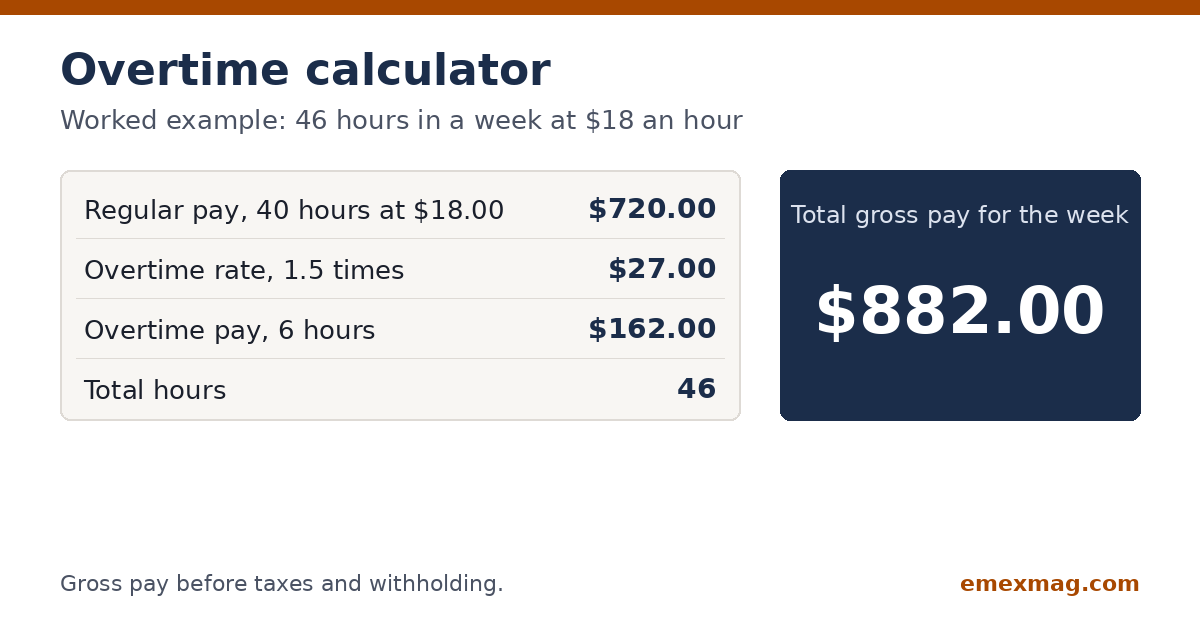
Sam earns $18.00 an hour and works 46 hours in one workweek. Regular pay is $18.00 × 40 = $720.00. The overtime rate is $18.00 × 1.5 = $27.00 an hour. Overtime pay is $27.00 × 6 = $162.00. Total gross pay is $882.00. Enter the same numbers in the overtime calculator and it gives the same figures.
The regular rate: bonuses and more than one pay rate
The regular rate is total pay for the workweek, apart from payments the law excludes, divided by total hours worked. Nondiscretionary bonuses count. The Department of Labor lists attendance bonuses, safety bonuses and production bonuses as examples. Discretionary bonuses and gifts do not count. When an employee works at two or more rates in one workweek, the regular rate is the weighted average of those rates: add the earnings from all rates and divide by the total hours.
The Department of Labor gives this example in Fact Sheet #56C. An employee earns $10.00 an hour, works 43 hours and earns a $50.00 nondiscretionary bonus. Total pay is $430.00 + $50.00 = $480.00. The regular rate is $480.00 ÷ 43 = $11.16. The straight-time pay already covers all 43 hours, so the overtime premium is half the regular rate: $5.58 × 3 overtime hours = $16.74. Total pay due is $496.74. The regular rate helper above reproduces this result. Like the Department of Labor examples, it rounds the regular rate to the nearest cent.
Salaried non-exempt employees
Fact Sheet #23 gives the method. An employee hired at a salary of $405 for a 45-hour week has a regular rate of $405 ÷ 45 = $9.00. The salary already pays straight time for all 45 hours, so the 5 overtime hours are owed an extra half of the regular rate: $4.50 × 5 = $22.50. Total pay due is $427.50.
The same rule applies when the salary covers fewer than 40 hours. The federal regulation at 29 CFR 778.113 gives the example of a $350 salary for a 35-hour week. The regular rate is $350 ÷ 35 = $10.00, so the employee is owed $10.00 for each of the first 40 hours and $15.00 for each hour after that. For 45 hours worked, that is $400.00 + $75.00 = $475.00. The salaried section of the calculator gives the same result. The regulation also says a monthly salary is turned into a weekly figure by multiplying by 12 and dividing by 52.
Double time calculator and daily overtime
Federal law does not require double time, and it does not require overtime for work on Saturdays, Sundays, holidays or days of rest as such. It also sets no daily overtime threshold. The Department of Labor’s FLSA questions and answers say the FLSA has no requirement for double time pay. Double time comes from state law, a union contract or an employer’s own policy. To use this page as a double time calculator, choose the multiplier of 2. At $25.00 an hour, double time is $50.00 an hour.
Some states go further than federal law. In California, for example, the state Labor Commissioner’s Office says overtime is one and one-half times the regular rate for hours over 8 and up to 12 in a workday, and for the first 8 hours on the seventh consecutive day of work in a workweek. It is double the regular rate for hours over 12 in a workday and for hours over 8 on the seventh consecutive day. Exceptions apply to some employees. See the California overtime FAQ. The daily overtime view lets you set your own thresholds. It counts each hour as overtime only once, and it does not apply seventh-day rules, so check your state labor office for the full rules.
Who is exempt from overtime?
Executive, administrative and professional employees can be exempt from federal overtime if they meet duties tests and are paid on a salary basis at or above a set level. When we checked on October 7, 2026, the Department of Labor’s earnings thresholds page gave the standard salary level as $684 a week, equal to $35,568 a year, and the total annual compensation level for highly compensated employees as $107,432. Check that page for the current figures. Some states set higher levels.
Questions about overtime pay
How do I calculate overtime pay?
Multiply your hourly rate by 1.5 to get the overtime rate, then multiply that by the hours you worked over 40 in the workweek. For example, at $20.00 an hour and 50 hours, regular pay is $800.00 and overtime pay is $30.00 times 10 hours, which is $300.00. Total gross pay is $1,100.00. The overtime calculator on this page shows each step.
How much is time and a half for $20 an hour?
Time and a half for $20.00 an hour is $30.00 an hour. Multiply the hourly rate by 1.5.
Is overtime after 8 hours a day or 40 hours a week?
Under federal law, overtime is due after 40 hours in a workweek. There is no federal daily overtime rule. Some states, such as California, also require overtime after 8 hours in a workday. Someone who works four 10-hour days has no federal overtime, but with a daily threshold of 8 hours they have 8 overtime hours.
Is double time required by law?
Federal law does not require double time. Some state laws do. California requires double the regular rate for hours over 12 in a workday and for hours over 8 on the seventh consecutive day of work in a workweek. Employers and union contracts can also offer double time by choice.
Do bonuses change the overtime rate?
Nondiscretionary bonuses must be included in the regular rate, so they raise the overtime due. In the Department of Labor example, an employee on $10.00 an hour who works 43 hours and earns a $50.00 bonus has a regular rate of $11.16 and is owed $496.74 for the week.
Do salaried employees get overtime?
Salaried employees get overtime unless they are exempt. To be exempt as an executive, administrative or professional employee under federal law, a person must meet duties tests and be paid at least the standard salary level. The Department of Labor website gave this level as $684 a week, or $35,568 a year, when we checked on October 7, 2026.
Related tools
- Pay raise calculator: new pay from a percent raise, for salary or hourly pay.
- Generation calculator: find a generation by birth year and see your workforce mix.
Use this overtime calculator to work out overtime pay at time and a half, double time or your own rate. It also finds the regular rate when a bonus is paid, and the overtime for salaried non-exempt staff.