Employee Cost Calculator: the True Cost of an Employee in 2026
This employee cost calculator shows what an employee costs a US employer in a year: pay, employer payroll taxes, and the benefits and overheads you enter. It gives the total annual cost, the cost for each hour worked and the load as a percent on top of pay, with the working shown.
This calculator shows the employer’s costs. It does not calculate employee withholding or take-home pay. Federal rules are shown and state rules can differ. It is general information, not tax advice.
Total employee cost calculator for a team
Paste up to 30 annual salaries, one per line, to see employer payroll taxes and the total cost for each person and for the team. Nothing you enter leaves this page.
Rates used: employer payroll taxes for 2026
| Tax | Employer rate | Applies to | Source |
|---|---|---|---|
| Social Security | 6.2% | The first $184,500 of each employee’s wages in 2026 | SSA contribution and benefit base, IRS Topic 751 |
| Medicare | 1.45% | All wages, with no cap | IRS Topic 751 |
| Additional Medicare Tax | None for the employer | Employers withhold 0.9% from an employee’s wages above $200,000. There is no employer match, so it is not a cost in this calculator. | IRS Topic 751 |
| Federal unemployment tax (FUTA) | 6.0%, or 0.6% after the full credit | The first $7,000 of each employee’s wages. The calculator uses 0.6%, which is $42 at most for each employee. | IRS Topic 759 |
| State unemployment tax | Varies | Your state sets the wage base and gives each employer a rate. Enter your own figures. | Your state workforce agency |
The FUTA credit of up to 5.4% is for employers who pay their state unemployment tax in full and on time. In a credit reduction state, which is a state that has not repaid federal loans for unemployment benefits, the credit is reduced and employers owe more FUTA than this calculator shows. The Department of Labor names the credit reduction states each year, and employers who paid wages in one file Schedule A (Form 940). IRS Topic 759 was last reviewed by the IRS on September 24, 2026, and refers to Form 940 for 2025.
How the true employee cost calculator works
The true cost of an employee is more than the salary in the offer letter. The calculator starts with annual pay. For hourly staff, annual pay is the hourly rate multiplied by hours a week and weeks paid a year. It then adds each employer payroll tax from the Rates used table and each cost you enter. The result is the fully loaded cost for the first year.
- Load percent is everything on top of pay, divided by pay.
- Cost for each hour worked is the total cost divided by the hours worked. Hours worked are the paid hours in the year less paid time off. One day of paid time off counts as one fifth of the weekly hours.
- Paid time off does not add a separate dollar cost, because it is already inside annual pay. It raises the cost of each hour worked.
- Recruiting is treated as a one-time cost in the first year. The result also shows the cost for later years without it.
- All pay is treated as taxable wages. Pre-tax benefit deductions, tips and other special cases are not covered.
Worked example
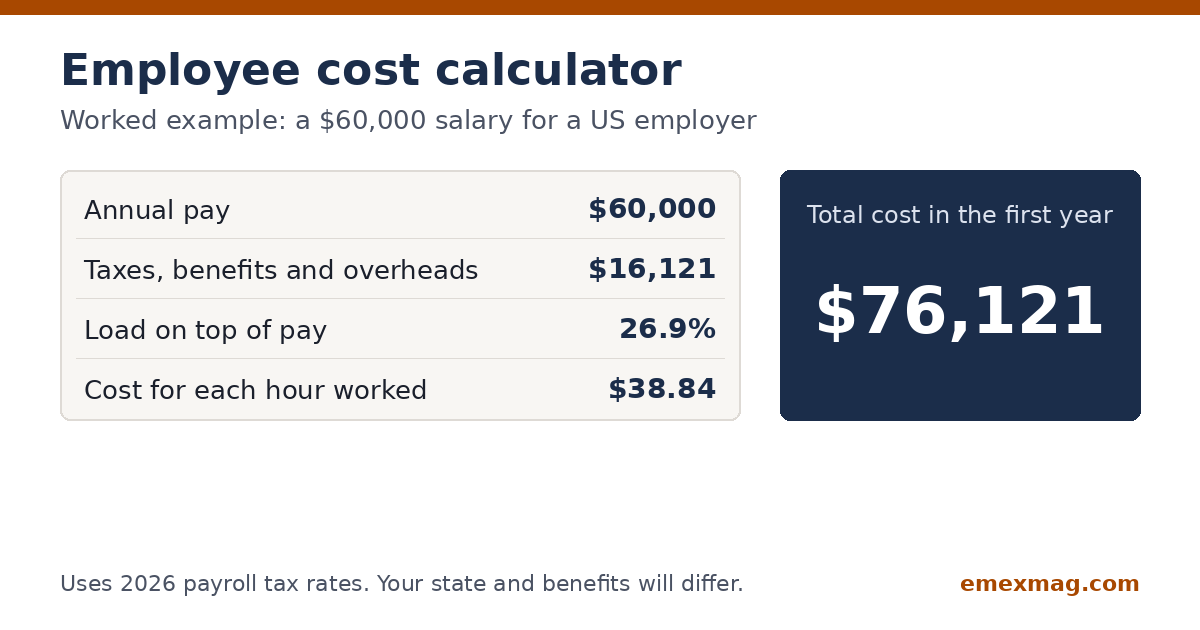
An employee earns a $60,000 salary and works 40 hours a week. The employer’s state unemployment tax rate is 2.7% on a $7,000 wage base. These two state figures are an example only and are not a rate for any state. The employer pays $500 a month for health insurance, a 4% retirement match and a workers’ compensation rate of $1 per $100 of pay. It spends $1,200 on equipment, $600 on software and $500 on training, and gives 15 days of paid time off.
- Social Security: 6.2% of $60,000 = $3,720
- Medicare: 1.45% of $60,000 = $870
- FUTA: 0.6% of $7,000 = $42
- State unemployment tax: 2.7% of $7,000 = $189
- Employer payroll taxes: $4,821
- Benefits and other costs: $6,000 + $2,400 + $600 + $1,200 + $600 + $500 = $11,300
- Total annual cost: $60,000 + $4,821 + $11,300 = $76,121
- Load on top of pay: $16,121 divided by $60,000 = 26.9%
- Hours worked: 2,080 less 120 hours of paid time off = 1,960. Cost for each hour worked: $38.84
Use the “Fill in the worked example” button above to check these figures.
Questions about the cost of an employee
What does an employee cost calculator include?
An employee cost calculator adds the costs an employer pays on top of wages. This one adds employer Social Security at 6.2% up to $184,500 of pay in 2026, employer Medicare at 1.45%, federal unemployment tax (FUTA), your state unemployment tax if you enter it, and the benefits and overheads you enter. It does not calculate employee withholding or take-home pay.
What is the true cost of an employee on a $60,000 salary?
Federal employer payroll taxes on $60,000 in 2026 are $4,632: $3,720 Social Security, $870 Medicare and $42 FUTA. In the worked example on this page, state unemployment tax of $189 and $11,300 of benefits and overheads bring the total to $76,121. That is a load of 26.9% on top of pay, or $38.84 for each hour worked. Your own figure depends on your state and your benefits.
What is a fully loaded cost?
Fully loaded cost is pay plus every cost the employer carries for that person: payroll taxes, benefits, insurance, equipment, software, training and recruiting. It is often shown as a percent on top of pay, called the load or burden rate. The calculator shows this percent and the working behind it.
How much are employer payroll taxes in 2026?
Employers pay 6.2% Social Security on the first $184,500 of each employee’s wages and 1.45% Medicare on all wages, which is 7.65% up to the wage base. FUTA is 6.0% on the first $7,000 of wages. Employers who pay state unemployment tax in full and on time can get a credit of up to 5.4%, which leaves 0.6%, or $42 an employee. State unemployment tax is extra and varies by state and employer.
How do I use this as a labor cost calculator for hourly staff?
Choose hourly pay, then enter the hourly rate, the hours a week and the weeks paid a year. The labor cost calculator works out annual pay, adds employer payroll taxes and the costs you enter, and divides the total by the hours worked after paid time off. For example, $25 an hour for 40 hours over 52 weeks is $52,000 of pay and $4,020 of federal employer payroll taxes.
Does paid time off change the cost of an employee?
It does not change the annual cost, because paid time off is already inside annual pay. It does raise the cost of each hour worked. In the worked example on this page, $76,121 spread over all 2,080 paid hours is $36.60 an hour. Taking off 15 days of paid time off leaves 1,960 hours worked, so the cost for each hour worked is $38.84.
Related tools
Use this employee cost calculator to see what an employee costs a US employer in a year. It adds payroll taxes, benefits and overheads to pay, and shows the cost for each hour worked.