Bradford Factor Calculator: Free Score, Trigger Points and What They Mean
Work out a Bradford factor score from a number of absence spells and total days absent, or from a list of absences. Nothing you enter is stored or sent anywhere. The sums run in your browser.
What if: the same days as one spell or several
The formula squares the number of spells, so the way the days are split changes the score far more than the number of days does.
| Pattern of absence | Working | Score |
|---|
This table uses 10 days until you calculate a score above. It then uses your total days, with your own result highlighted.
How the Bradford factor is calculated
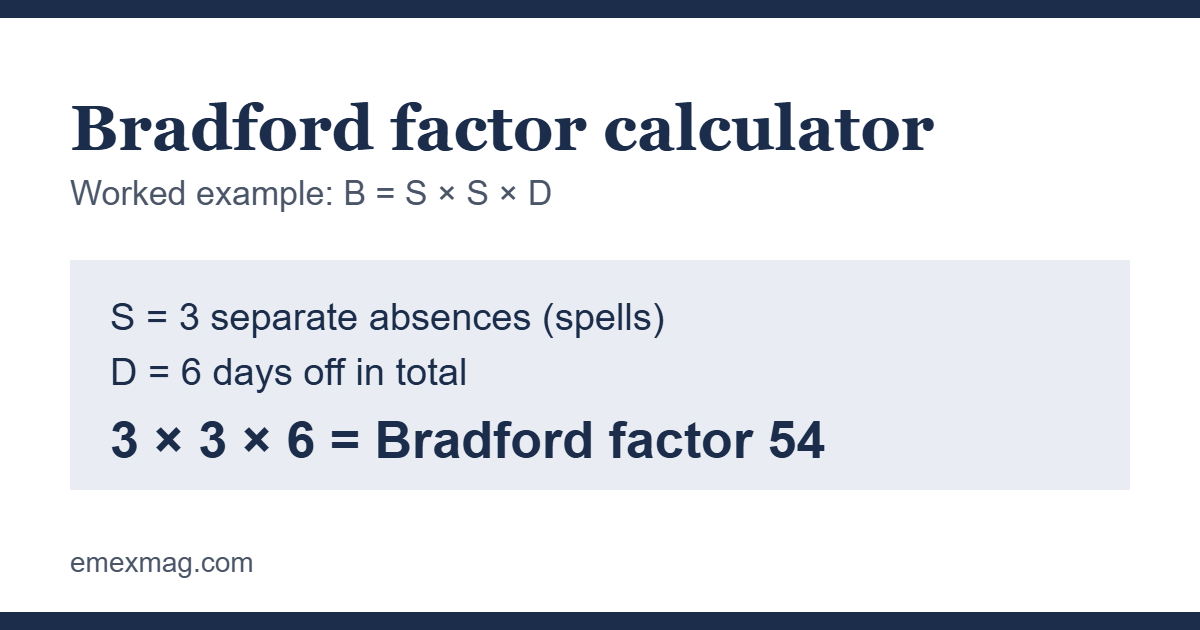
The formula is B = S x S x D.
- S is the number of separate spells of absence in the period.
- D is the total number of days absent in the same period.
- B is the Bradford factor score.
The three policies quoted below all use a rolling 12 months. Some employers use 52 weeks instead. Check which period your policy uses. Days are usually working days absent. Check that too, because counting weekends inside a spell raises the score.
Worked example
An employee has had three spells of absence in the last 12 months: two days, one day and four days. That is 3 spells and 7 days. The score is 3 x 3 x 7 = 63. If the same 7 days had been one spell, the score would be 1 x 1 x 7 = 7.
Trigger points that named employers publish
These are examples from published policies. They show how much trigger points differ. They are not a standard.
| Employer | Trigger point | What the policy says happens |
|---|---|---|
| Great Yarmouth Borough Council | 20 to 50, then 51 and above | Informal action at 20 to 50. A stage 1 meeting at 51 and above. |
| Royal Veterinary College (information sheet reviewed June 2021) | 99 | Staff who reach the first trigger point are initially referred to occupational health. Absence relating to maternity, disability and injury at work is left out of the calculation. |
| South Oxfordshire District Council (policy effective October 2022) | More than 200 | One of several triggers. The others are 3 absences in a rolling 6 months, 5 in a rolling 12 months, or a pattern of absence. Each period of sickness is assessed individually. |
Sources: Great Yarmouth Borough Council sickness absence management policy, Royal Veterinary College Bradford factor information sheet and South Oxfordshire District Council sickness absence policy. Checked October 2026. Policies change, so read the current version before you quote one.
Using the score fairly
The score is a count. It does not know why someone was absent. These points help you use it as one input alongside the facts of each case.
Treat a trigger as a prompt for a conversation
Acas guidance on absence review points says an employer should not use them to automatically trigger disciplinary action for absence. A trigger tells a manager it is time to talk to the employee, find out what is behind the absences and agree any support.
Disability-related absence
Acas gives the example of a disabled employee who needs time off for regular medical treatment and so reaches review points more quickly. Regular short absences are exactly the pattern that the formula scores highest. The Equality Act 2010 says employers must make reasonable adjustments for disabled employees. Acas gives two examples of being flexible: adjust the review points for that employee, or decide that disability-related absence will not count towards them.
Pregnancy-related absence
Acas says an employer reviewing absence should consider whether it is related to pregnancy, and might need to take a different approach. One option it gives is to leave pregnancy-related absence out of review points. Under section 18 of the Equality Act 2010, treating a woman unfavourably because of pregnancy-related illness during the protected period is pregnancy discrimination. The protected period runs from the start of the pregnancy, usually to the end of maternity leave or her earlier return to work. The Royal Veterinary College’s information sheet, for example, leaves absence relating to maternity out of its calculation.
Long-term conditions and one long absence
One long absence gives a low score, and a condition that flares up now and again gives a high one. The score therefore says little about long-term absence.
Practical checks before you act on a score
- Check the absence record is right, including the dates and the reason recorded for each spell.
- Ask whether any spell is linked to a disability, a pregnancy or an injury at work.
- Ask whether a condition is still being diagnosed. If an absence review suggests the employee could be disabled, Acas says the employer should consider that and what adjustments could help.
- Apply the same trigger points and the same process to everyone covered by the policy, and record the reason when you adjust them for someone.
Sources: Acas, absence trigger points, Acas, reasonable adjustments at work and Equality Act 2010, section 18. This page is general information, not legal advice.
Questions about the Bradford factor
How do you calculate the Bradford factor?
Multiply the number of separate spells of absence by itself, then multiply by the total days absent in the same period. The formula is B = S x S x D. For example, 3 spells adding up to 7 days gives 3 x 3 x 7 = 63. Count both over the period your policy names, often a rolling 12 months.
What is a good Bradford factor score?
There is no official scale, so no score is good or bad in itself. A score of 0 means no absence in the period. Each employer that uses the Bradford factor sets its own trigger points. As examples from published policies, Great Yarmouth Borough Council starts informal action at 20 and a stage 1 meeting at 51, the Royal Veterinary College sets its first trigger point at 99 and South Oxfordshire District Council uses a score of more than 200 as one of several triggers. A score below the first trigger point in your own policy does not prompt any action under that policy.
Is 72 a bad Bradford factor score?
It depends on the policy. A score of 72 could come from 2 spells and 18 days, 3 spells and 8 days, or 6 spells and 2 days. Under Great Yarmouth Borough Council’s published policy, 72 is above the 51 that leads to a stage 1 meeting. It is below the Royal Veterinary College’s first trigger point of 99 and below the 200 that South Oxfordshire District Council uses. Compare it with your own policy and look at the reasons for the absences as well as the score.
What is a sackable Bradford score?
No score is automatically grounds for dismissal. Employers set their own trigger points, and reaching one usually leads to a meeting or the next stage of the absence procedure. Acas says review points should not automatically trigger disciplinary action. In Great Yarmouth Borough Council’s policy, for example, dismissal is one possible outcome of a stage 3 hearing, after earlier stages have not led to improvement. A fair process means looking at the reasons for the absences, any link to disability or pregnancy, and the support or adjustments already tried.
What period does the Bradford factor cover?
Policies commonly use a rolling 12 months, and some use 52 weeks. The formula works for any period, as long as spells and days are counted over the same one. A shorter period gives lower scores, so trigger points only make sense for the period the policy names.
Why does one long absence score lower than several short ones?
The formula multiplies the number of spells by itself, so spells count for much more than days. One spell of 10 days scores 10. Five spells adding up to the same 10 days score 250. The measure was designed to pick out frequent short absences, so it says little about long-term absence.
Can the Bradford factor disadvantage disabled employees?
It can. A disabled employee who needs regular time off for treatment, or whose condition flares up from time to time, will build a high score quickly. Acas says employers should not use absence review points to automatically trigger disciplinary action. It gives adjusting review points, or leaving disability-related and pregnancy-related absence out of the count, as examples of being flexible. The Equality Act 2010 says employers must make reasonable adjustments for disabled employees.
More from Employee Experience Magazine
Related calculators
Weekly newsletter
Research, news and practical ideas for people leaders, sent once a week.
Use this Bradford factor calculator to turn a run of absences into a score. Read the trigger points as a prompt for a fair conversation, not as an automatic decision.