NPS Calculator
This NPS calculator works out a Net Promoter Score from your survey answers and shows every step. Enter totals for each group, a count for each score from 0 to 10, or paste the raw scores. Nothing you enter leaves this page.
How to calculate NPS
The survey asks one question: how likely are you to recommend us to a friend or colleague? People answer on a scale from 0 to 10. Fred Reichheld, a partner at Bain & Company, created the measure in 2003 (see Bain’s About the Net Promoter System page). Bain groups the answers like this.
| Group | Score given | Effect on the result |
|---|---|---|
| Promoters | 9 or 10 | Added |
| Passives | 7 or 8 | Counted in the total only |
| Detractors | 0 to 6 | Subtracted |
The score is the percentage of promoters minus the percentage of detractors (source: Bain & Company, Measuring Your Net Promoter Score). Because it is one percentage minus another, it runs from −100, where everyone is a detractor, to +100, where everyone is a promoter. It is usually written as a number without a percent sign.
NPS calculator worked example
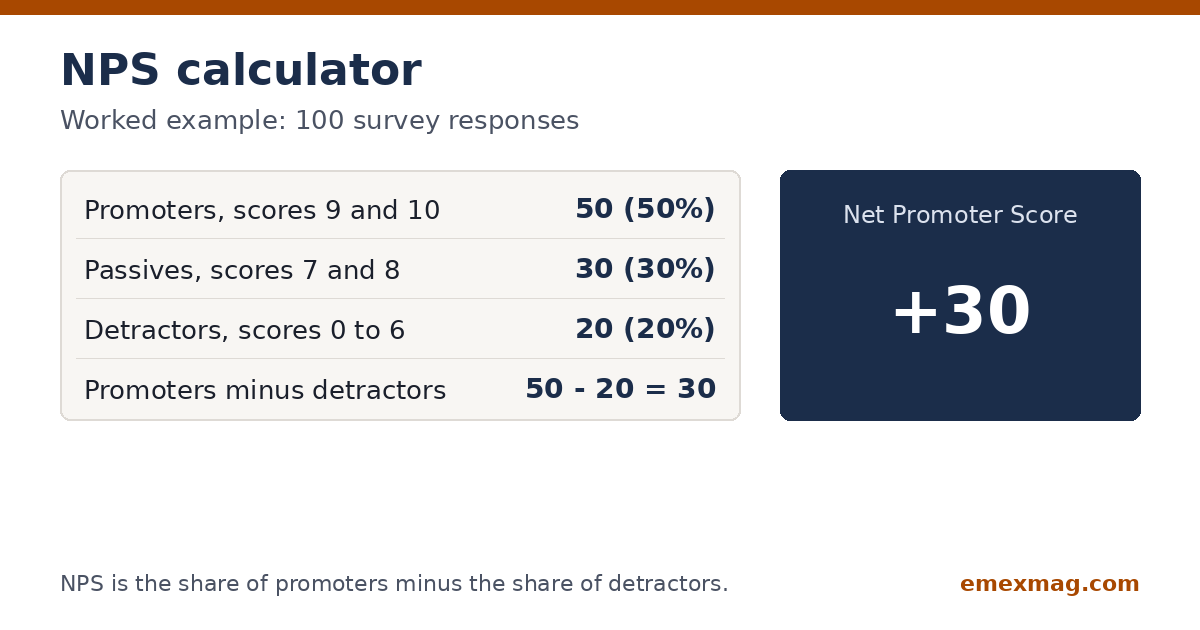
A survey gets 100 responses: 50 promoters, 30 passives and 20 detractors.
- Promoters: 50 ÷ 100 = 50%.
- Detractors: 20 ÷ 100 = 20%.
- Score: 50 − 20 = +30.
- Approximate margin of error at 95% confidence: plus or minus 15.3 points, so the result for the whole group surveyed could sit anywhere from about +15 to +45.
Enter 50, 30 and 20 in this net promoter score calculator and you will get the same figures.
About the margin of error
A survey usually hears from only some of the people it could have asked, so the result carries some uncertainty. The calculator gives an approximate margin of error using a standard formula. With p as the share of promoters and d as the share of detractors, both as decimals, and n as the number of responses:
Margin of error = 1.96 × 100 × √( (p + d − (p − d)²) ÷ n )
The 1.96 gives 95% confidence. This is the standard large-sample formula for a score made from two shares of the same set of responses. MeasuringU uses the same variance in an adjusted version for small samples, which adds 3 to the number of responses and three quarters to each of the promoter and detractor counts, so its figures differ a little from this calculator. Treat the figure as a rough guide. It assumes the people who answered are a random sample of a much larger group. It says nothing about bias from who chose to reply. If you surveyed everyone and nearly everyone answered, the true uncertainty is smaller.
eNPS: using the employee net promoter score calculator sensibly
Employee Net Promoter Score (eNPS) uses the same arithmetic with a question about work, such as: how likely are you to recommend us as a place to work? Select the employee survey box above and the results use eNPS wording. Some notes for HR and people teams:
- Small teams make the score jumpy. In a team of 10, one person moving from detractor to promoter moves the score by 20 points. The calculator shows this figure for your response count.
- Set an anonymity threshold. Decide the smallest group you will report on before the survey goes out, tell employees what it is, and do not show results for groups below it. Watch for filters that can be combined to single out one person.
- Ask a follow-up why question. The number tells you where you stand. An open question such as “What is the main reason for your score?” tells you what to work on.
- Track the trend. One result on its own says little. The same question, asked the same way at regular intervals, shows the direction of travel.
- Do not rank managers on it alone. Team scores differ for reasons outside a manager’s control, such as workload, pay, location and team size. Small teams also swing more by chance. Use the score to start a conversation and read it with other evidence.
Questions about NPS and eNPS
What is the formula for NPS?
NPS equals the percentage of promoters minus the percentage of detractors. Promoters score 9 or 10, passives score 7 or 8 and detractors score 0 to 6. With 50 promoters, 30 passives and 20 detractors out of 100 responses, the score is 50 minus 20, which is +30. The NPS calculator on this page shows this working for your own figures.
Do passives count in the calculation?
Yes, in the total. Passives are not added or subtracted, but they are part of the number of responses that the percentages are based on. More passives pull both percentages down. With 50 promoters, 20 detractors and no passives, the score would be about +43. With 30 passives added it is +30.
Can NPS be negative?
Yes. The score runs from -100 to +100. It is negative whenever there are more detractors than promoters. For example, 20 promoters, 30 passives and 50 detractors gives 20 minus 50, which is -30.
What is a good NPS or eNPS score?
There is no single number that counts as good. Any score above zero means you have more promoters than detractors. Benchmarks vary by industry, by country and by how the survey is run, so this page does not quote one. The most useful comparison is with your own earlier results, measured the same way.
How is eNPS calculated?
The same way as NPS. Employees answer a question such as how likely they are to recommend their employer as a place to work, on a scale from 0 to 10. Subtract the percentage scoring 0 to 6 from the percentage scoring 9 or 10. If 12 of 40 employees are promoters and 8 are detractors, eNPS is 30 minus 20, which is +10.
How many responses do I need?
There is no fixed minimum, but fewer responses mean a wider margin of error. With 50 promoters, 30 passives and 20 detractors from 100 responses, the approximate margin of error is plus or minus 15.3 points. With the same split from 400 responses it is plus or minus 7.7 points.
Related tools
Net Promoter, NPS and Net Promoter System are registered trademarks of Bain & Company, Inc., NICE Systems, Inc. and Fred Reichheld. Net Promoter Score is a service mark of Bain & Company, Inc., NICE Systems, Inc. and Fred Reichheld. This calculator is independent and is not connected with or endorsed by them.
Use this NPS calculator to turn promoter, passive and detractor counts into a Net Promoter Score. It also works out eNPS for employees, and it shows the working and the margin of error.