One on One Meeting Questions: 210 Questions and Agenda Builder

One on One Meeting Questions: Build Your Agenda
This page lists 210 one on one meeting questions, 120 for managers to ask and 90 for employees to ask their manager, and builds them into an agenda with timings. Say who you are, what the situation is and how long you have. The builder proposes 3 to 7 questions. You can swap any of them, add your own items, then copy or print the agenda. Every question is also listed further down the page.
Nothing you choose or type here is stored or sent anywhere. The agenda lasts until you close or reload the page.
How the 1:1 meeting agenda is built
The builder treats 1 on 1 meeting questions as prompts for a conversation and keeps the number low. It takes one question from each theme you ticked, starting with the themes that fit your situation, and goes around again if there is room.
- 15 minutes: 1 minute to open, 3 questions at 4 minutes each, 2 minutes for actions.
- 30 minutes: 3 minutes to open, 5 questions at 4 minutes each, 3 minutes for anything else, 4 minutes for actions.
- 60 minutes: 5 minutes to open, 7 questions at 6 minutes each, 7 minutes for anything else, 6 minutes for actions.
The timings are rough guides. If the first question opens up something that matters, stay with it and carry the others over to next time. Items you add yourself get the same time as a question, and the builder tells you when the total goes over the meeting length.
Worked example
Choose “A manager”, “A regular check-in” and “30 minutes”. The builder ticks three themes: Check-in, Priorities and blockers, and Feedback both ways. Select “Build my agenda”. You get 5 questions at 4 minutes each: two from Check-in, two from Priorities and blockers and one from Feedback both ways, starting with “What’s on your mind this week?”. With 3 minutes to open, 3 minutes for anything else and 4 minutes for actions, the agenda adds up to 30 minutes. Select “Swap” beside the first question and it changes to the next Check-in question that is not already on the agenda, “What has gone well since we last spoke?”.
A simple one on one meeting template
If you want one page to reuse every time, copy this one on one meeting template into a shared document that both of you can edit. Add each new meeting at the top so the history stays in one place.
ONE-ON-ONE: [employee] and [manager]
Date: [date]   Length: 30 minutes

1. Your items (employee goes first) (10 min)
   -
   -

2. Priorities and blockers (8 min)
   - What matters most before we next meet?
   - What is stuck, and who can unblock it?

3. Feedback, both ways (5 min)
   - One thing that went well, one thing to change

4. Growth (once a month) (4 min)
   - One step toward what you want to be doing next

5. Actions (3 min)
   - Who / what / by when
   - Who / what / by when

Carried over from last time:
   -
Running one on ones that people want to keep
Cadence
Thirty minutes every week or every two weeks suits most working relationships. Go weekly with a new hire for the first 90 days, with someone whose role is changing, and with anyone you do not otherwise see during the week. A monthly meeting can leave a small problem to grow for weeks before anyone raises it.
Keep the slot. If you have to move a meeting, move it within the same week. A manager who cancels one-on-ones when things get busy teaches the team that the meeting is the first thing to go, and people stop saving things for it.
Whose meeting it is
It is the employee’s meeting. Their items go first and take most of the time. The manager’s job is to ask, listen, decide what only a manager can decide, and remove what is in the way. A useful check for managers is how much of the time you spent talking. If it is more than half, the meeting has turned into a briefing.
Employees can make this easier by arriving with two or three items and saying which one matters most. The one on one questions to ask your manager further down this page are written for that.
Asking for feedback
Asking for feedback only helps if the other person feels able to answer honestly. Amy Edmondson defined team psychological safety as "a shared belief held by members of a team that the team is safe for interpersonal risk taking" (Edmondson, 1999, Administrative Science Quarterly). Her definition is about teams. In a one-on-one, the practical test is what you do after someone tells you something uncomfortable. Thank them, act on one thing, and tell them what you did.
Notes and follow-through
Keep one shared document per person, with the newest meeting at the top. Write down the actions and nothing more: who, what and by when. Start the next meeting by reading the last set of actions. Managers should do their own actions first, because a manager who does not follow through is the quickest way to empty the meeting of anything real.
Keep the shared notes factual. A one-on-one document is a working record, and both of you should be comfortable with what is in it.
What not to use the time for
- Status updates. Put them in writing beforehand and use the meeting for what the update raises.
- Saving up feedback. If something needs saying today, say it today.
- Formal conversations by surprise. A performance warning or a disciplinary matter needs its own meeting, with notice and under your organization’s procedure.
- Talking about people who are not there. Asking for help with a working relationship is fine. A running commentary on a colleague is not.
- The manager’s to-do list. If you are handing out tasks for 25 minutes, send them in a message and give the time back.
- Personal questions. Do not ask about health, family or life outside work. Ask about the work, and let the other person decide what else to share.
210 one on one meeting questions, by purpose
The full list, grouped by what you want the conversation to do. Each theme has one on one questions for managers and a second list of one on one meeting questions for employees to ask their manager. The agenda builder draws from these same lists.
Check-in questions
Openers that hand the agenda to the other person. One is enough for most meetings.
One on one questions for managers to ask
- What’s on your mind this week?
- What would you like to use this time for today?
- What has gone well since we last spoke?
- What has been harder than you expected?
- How has this week felt compared with a typical one?
- What’s taking up more of your attention than it should?
- What are you most pleased with from the last two weeks?
- Is there anything you’ve been meaning to raise and haven’t found the moment for?
- What’s one thing that would make next week better than this one?
- What have you been working on that I probably haven’t seen?
- Where would a decision from me help right now?
- What did we talk about last time that we should come back to?
One on one meeting questions to ask your manager
- What’s on your mind this week that I should know about?
- What has changed since we last spoke that affects my work?
- What are you hearing from your own manager that I should be aware of?
- Is there anything coming up that I should start preparing for?
- What would you like more visibility of from me?
- How do you think the last two weeks have gone for the team?
- What should I be asking you that I’m not?
- Is there anything you need from me before we next meet?
- Which of my updates do you find useful, and which could I drop?
Questions about priorities and blockers
Use these to agree what matters most and to find what is stuck. They are not a request for a status report.
For managers to ask
- What are your top three priorities this week, in order?
- Which of your priorities is most at risk?
- What’s blocking you that I could remove?
- What are you waiting on, and from whom?
- If you had to drop one thing this month, what would it be?
- Which of your priorities do you think I would rank differently?
- Where are you unclear on what "done" looks like?
- What decision is stuck, and who needs to make it?
- Which deadline worries you most?
- What have you said yes to that you now wish you’d pushed back on?
- Where are you having to guess what I want?
- What would you do with an extra half day this week?
For employees to ask their manager
- Of everything I’m working on, what matters most to you right now?
- If I can only finish two of these three things this week, which two?
- What does a good result look like on this piece of work?
- Who needs to be consulted before I go any further?
- What can I stop doing to make room for this?
- Can you help me get an answer from another team on something that’s stuck?
- How much of this do you want to see before it goes out?
- What’s the real deadline, and what is driving it?
- Which decisions on this can I make without checking with you?
Feedback questions, in both directions
Managers who ask for feedback before they give it tend to get a better hearing. Ask about something specific and recent.
For managers to ask
- What’s one thing I could do differently that would make your work easier?
- What am I doing that helps, so that I keep doing it?
- Is there anything I’ve done recently that got in your way?
- Am I giving you too much direction, too little or about the right amount?
- How do you prefer to hear feedback: in the moment, in our one-on-one or in writing?
- What feedback have you had recently from someone else that was useful?
- Is there a piece of work you’d like my honest view on?
- Thinking about the last piece of work you finished, what would you do differently next time?
- Is there feedback I’ve given you that didn’t make sense or didn’t seem fair?
- What do you think you’re doing well that isn’t getting noticed?
- Where would you like me to speak up for your work more?
- How well do I explain the reasons behind my decisions?
For employees to ask their manager
- If I changed one thing about how I work, what should it be?
- What should I keep doing exactly as I am?
- How do you think my last piece of work was received?
- Where do you think I’m underselling myself?
- What would you need to see from me to trust me with something bigger?
- Is there any feedback you’ve been saving that would help me now?
- How am I doing against what you expected at this point in the year?
- Can I give you some feedback on how we work together?
- What are you hearing about my work from other people?
Growth and career questions
Career conversations get lost when they wait for the annual review. Put one of these on the agenda every month or two.
For managers to ask
- What kind of work do you want more of over the next year?
- Which skill would you most like to build, and what would help?
- What part of your job has stopped stretching you?
- Where would you like to be in two years? It doesn’t have to be here, and it doesn’t have to be a promotion.
- Who in the organization does a job you’d like to understand better?
- What would you like to be known for?
- Is there a project coming up that you’d like to be part of?
- What have you learned recently that we’re not yet using?
- How clear is the route from your role to the next one?
- What’s getting in the way of your development right now?
- Would a mentor outside this team be useful to you?
- How much of what you wanted from this job when you took it are you getting?
For employees to ask their manager
- What would I need to show to be ready for the next level?
- Which skills should I be building for where this team is going?
- Is there a stretch project I could take on in the next six months?
- Who should I be getting to know outside this team?
- What’s the gap between how I work now and how someone a level up works?
- Can we set aside budget or time for a course I have in mind?
- What career paths have you seen people take from this role?
- Would you support me in spending time with another team to learn their work?
- When is the right time for us to talk about my pay and grade?
Workload and wellbeing questions
These are about the job: volume, pace, hours and time off. They do not ask about anyone’s health or home life, and a manager should not ask about those.
For managers to ask
- How manageable is your workload right now?
- What does your week look like, and where is it too full?
- Are you finishing your days at a reasonable time?
- Do you have time off booked in the next few months?
- Which piece of work is taking more out of you than it should?
- What could I take off your plate this month?
- Is the pace we’re working at sustainable for another quarter?
- Which meetings could you drop without losing anything?
- Do you get enough uninterrupted time for work that needs concentration?
- Which parts of the job give you energy, and which drain it?
- Is there anything about how or when you work that you’d like to change?
- How would I know if things were getting to be too much?
For employees to ask their manager
- I have more work than hours this month. Can we decide together what moves?
- Which of my tasks could someone else pick up?
- What do you expect from me on replying to messages outside working hours?
- Can we protect some time in my week for focused work?
- Which meetings do you need me in, and which can I skip?
- I’m planning time off in [month]. What should we sort out before I go?
- Can we talk about a change to my working pattern?
- How long do you expect this busy period to last?
- What would you like me to do when two urgent requests arrive at once?
Questions about the team and working relationships
Ask what the person has seen and tried. Avoid inviting comment on a colleague who is not in the room to answer.
For managers to ask
- How is the team working together at the moment, from where you sit?
- Who has helped you recently that I should know about?
- Is there anyone you’re finding it hard to work with? What have you tried so far?
- Which other team do we need a better relationship with?
- Where is work falling between people?
- Whose opinion on the team do we not hear enough?
- How useful are our team meetings to you?
- Is there tension in the team that I may not be seeing?
- Who would you like to work with more?
- How well do handoffs between you and other people work?
- What’s one team habit you’d change?
- Do you feel able to disagree in team meetings?
For employees to ask their manager
- How do you think I’m working with the rest of the team?
- I’m finding it hard to work with someone. Can I talk it through with you?
- Who should I go to for what on this team?
- Could you introduce me to someone in another team I need to work with?
- How would you like me to handle a disagreement with a colleague before I bring it to you?
- Who are the stakeholders for my work that I haven’t met yet?
- Can we clarify who owns what between me and a colleague?
- What do other teams say about working with us?
- How can I be more useful to the rest of the team?
Questions for times of change and uncertainty
During a reorganization or a change of direction, people want to know what is decided, what is not, and when they will hear. Say "I don’t know yet" when that is the answer.
For managers to ask
- What have you heard about the change, and what questions has it raised for you?
- What are people saying about the change that I should address?
- What concerns you most about what’s happening?
- What’s unclear about how this affects your role?
- What do you need from me while things are uncertain?
- What should we be careful not to lose through this change?
- How is the team taking the news, as far as you can tell?
- If I had more information tomorrow, what would you want to know first?
- What do you think of the change so far?
- What’s getting harder to do because of the change?
- How well have we explained why this is happening?
- I can’t answer everything yet. Which unanswered question matters most to you?
For employees to ask their manager
- What do you know about the change that you’re able to share?
- What’s decided, and what’s still open?
- How does this affect my role and my priorities?
- When will we know more, and how will we hear?
- What should I carry on doing as normal in the meantime?
- Who is making the decision, and can we feed into it?
- What would you do in my position right now?
- What should I say when people outside the team ask me about it?
- Is there anything you can’t tell me yet? I’d prefer to know that than guess.
First 90 days questions
For a new hire and their manager. Meet weekly for the first three months, even if you move to every two weeks later.
For managers to ask
- What has surprised you most since you started?
- What’s different from what we told you during hiring?
- What do you still not know how to do, or where to find?
- Who have you met so far, and who do you still need to meet?
- Which system or process is giving you the most trouble?
- What would you like to be doing on your own by the end of next month?
- How does the pace compare with what you expected?
- What have you noticed, as someone new, that the rest of us have stopped seeing?
- Is there anything about how we work that nobody has explained?
- What was most useful in your first week, and what was missing?
- How would you like me to check your work while you’re learning?
- What would help you feel part of the team?
For employees to ask their manager
- What does a good first 90 days look like to you?
- What should I have finished by the end of my first month?
- Who are the five people I most need to get to know?
- What do people new to this team usually get wrong?
- How will you tell me if I’m off track?
- What should I read to understand the history of this work?
- What should I not try to change in my first few months?
- How do you like to be kept updated?
- What did the last person in this role do well that I should keep going?
Remote and hybrid questions
When you do not share an office, the one-on-one carries more weight. These questions cover contact, visibility and how you reach each other.
For managers to ask
- What’s harder for you to do remotely than in person?
- Do you get enough contact with the rest of the team?
- What do you miss hearing when you’re not in the room?
- How well is our mix of office days and remote days working for you?
- Which of our meetings would work better as a written update?
- Do you have the equipment you need where you work?
- When you’re in the office, is the time well used?
- How easy is it to reach me when you need a quick answer?
- Are you able to switch off when your working day ends?
- Is there anything you’d like to be included in that you currently aren’t?
- What would make working across our different schedules or time zones easier?
- Do you feel your work is as visible as the work of people who are in the office more?
For employees to ask their manager
- What hours do you expect me to be reachable?
- Which days is it most useful for me to be in the office?
- How would you like me to keep you updated when we don’t see each other?
- Which questions can wait for our one-on-one, and which need a message straight away?
- What’s the best way to get a quick answer from you?
- Am I missing anything by not being in the room for certain conversations?
- Can we agree which meetings need cameras on?
- How will you judge my work when you can’t see me doing it?
- Could we meet in person now and then, and what would we use that time for?
Skip-level meeting questions
A skip-level is a one-on-one with your manager’s manager, or with someone who reports to one of your direct reports. In this theme, "questions for managers" are for the senior leader to ask.
For the senior leader to ask
- What’s it like to work in your team at the moment?
- What do you think I don’t know about how things work at your level?
- What’s one thing the leadership team should stop doing?
- Which recent decision from above would you like explained better?
- What gets in the way of your team doing its best work?
- How well do you understand where we’re heading and why?
- What are customers, or the people you serve, telling you that I should hear?
- What would you do in my job that I’m not doing?
- What do you need from me that you’re not getting through the normal channels?
- What does your manager do well that I should know about?
- Is there an idea you’ve raised that went nowhere?
- What would make you proud to tell people you work here?
To ask your manager’s manager
- What are your priorities for the next year, and where does my team fit?
- What does success look like for our part of the organization?
- What do you wish people at my level understood about decisions at yours?
- What worries you most about the business right now?
- How do you like to hear about problems from people a few levels down?
- What skills will this organization need more of in the next few years?
- What has helped you most in your own career?
- What’s one thing our team could do that would help you most?
- Would you be open to meeting again in a few months?
Questions about one on one meetings
What are good one on one meeting questions?
Good one on one meeting questions are open, about something recent, and lead to a decision or an action. Three from this page are "What’s blocking you that I could remove?", "Where are you having to guess what I want?" and "What’s one thing I could do differently that would make your work easier?". This page lists 210 questions in 10 themes: 120 for managers to ask and 90 for employees to ask their manager.
What one on one questions should I ask my manager?
Ask about priorities, decisions and feedback, because those are the things only your manager can give you. Examples from this page are "Of everything I’m working on, what matters most to you right now?", "Which decisions on this can I make without checking with you?" and "What would I need to show to be ready for the next level?". Choose "An employee" in the agenda builder to see only questions written for you to ask.
How many questions should I bring to a one on one?
Fewer than you think. The agenda builder on this page proposes 3 questions for a 15 minute meeting, 5 for 30 minutes and 7 for 60 minutes, and leaves time for the other person’s items and for agreeing actions. One question that gets a full answer is worth more than five that get a sentence each.
What should a 1:1 meeting agenda include?
A 1:1 meeting agenda needs four parts: the employee’s own items first, priorities and blockers, feedback in both directions, and the actions you have each agreed with a date. Add a growth or career item about once a month. The one on one meeting template on this page sets this out for a 30 minute meeting.
How often should managers hold one on one meetings?
Weekly or every two weeks suits most teams, for 30 minutes. Meet weekly with a new hire in their first 90 days and with anyone going through a change in their role. A regular slot that is kept matters more than the exact interval, so move a meeting when you have to and avoid canceling it.
What should you not use a one on one for?
Do not use it for status updates that could be written down, for holding back urgent feedback until the next meeting, for a formal performance or disciplinary conversation with no warning, or for talking about colleagues who are not there. Those uses crowd out the things the meeting is for.
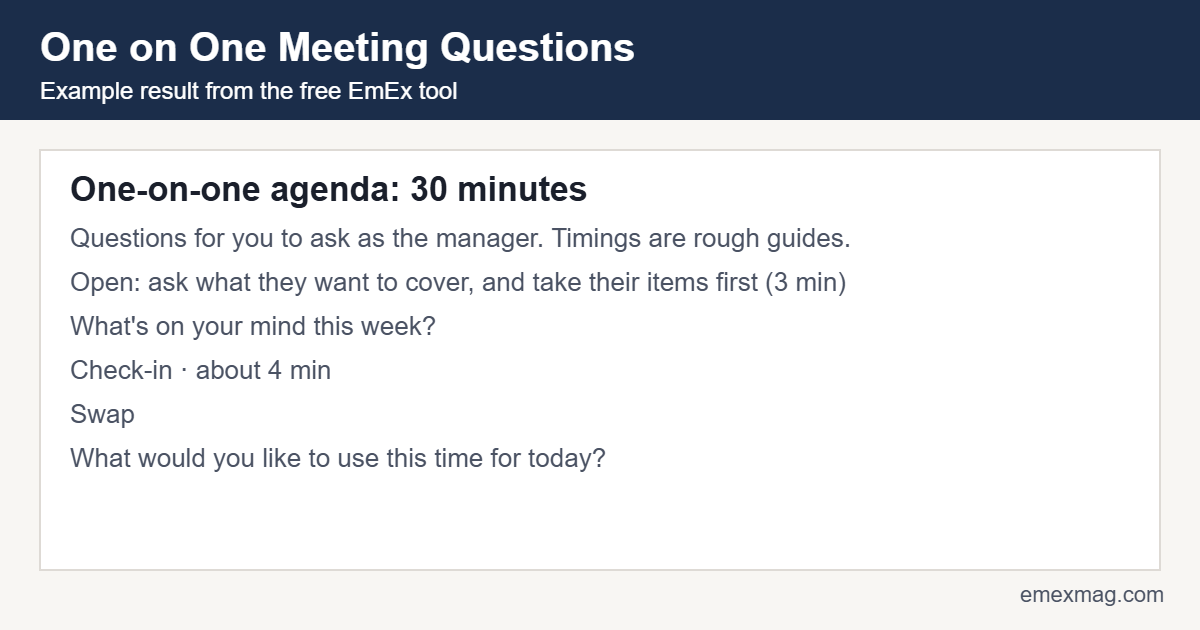
Use these one on one meeting questions to plan an agenda that helps both people use the time well.
Looking after your team: find a team experience
Looking for something different for your team? The EmEx Something Different directory lists unusual team experiences from UK and US suppliers. You contact the supplier direct, with no fees or commission.