Self Evaluation Examples

Self Evaluation Examples: Builder for Your Performance Review
These self evaluation examples cover 14 competencies and three kinds of year: strong, solid and difficult. Pick your role level, the competencies on your form and how the year went. The builder assembles a draft with a prompt under each statement to add your own evidence. Nothing you choose or type leaves this page.
How the builder works
The builder holds 224 statements, all written by hand for this page. Most competencies have a set for a strong year, a solid year and a difficult year, with extra statements for managers and senior leaders. “Areas to improve”, “Goals for next period” and “Support I need from my manager” do not change with the kind of year.
Every statement has gaps in square brackets, such as [number], [date] and [project]. They mark where your own facts go. Under each statement the builder adds a prompt in brackets that asks for a number, a date or an example. “Another phrasing” swaps one statement for a different one on the same competency and leaves the others alone. The word count covers the whole draft, prompts included. “Copy draft” puts the text on your clipboard and “Print draft” opens your browser’s print window with the draft only.
Worked example
Choose “Individual contributor” and “Strong year”, press “Clear all”, then tick “Quality of work” and press “Build my draft”. The builder gives:
Self-evaluation Quality of work My work on [project or deliverable] passed review with [number] changes requested, against a team norm of [number]. I check my own work against [standard or checklist] before I hand it over, and [reviewer or stakeholder] has relied on it without rework since [month]. [Add a number, date or example here: an error rate, a review result or a named piece of work.]
The word count shows 67 words, which includes the heading, the competency name and the evidence prompt. A finished version might read: “My work on the supplier onboarding guide passed review with 2 changes requested, against a team norm of 6.” The second version is shorter and a manager can check it.
How to write a performance review self evaluation
A performance review self evaluation is your account of the year, written before your manager writes theirs. In practice it often becomes the first draft of your review, because a busy manager will reuse what you give them. That is the reason to make it specific.
Evidence over adjectives
“I am a strong communicator” asks the reader to take your word for it. “I rewrote the returns guide in March, and questions to the support inbox about returns fell from 40 to 12 a week” gives them something they can repeat in a calibration meeting. For each statement, add at least one of these: a number, a date, a named piece of work, or something another person said or did as a result.
| Adjective only | With evidence |
|---|---|
| I am very reliable. | I delivered 11 of 12 commitments on time. The late one was the pricing report, which was 3 days late. |
| I am a great team player. | I covered the invoicing queue for 4 weeks in May and handed it back with notes on each open case. |
| I showed strong leadership. | I led a 5 person project group that moved the rota to the new system by October 1, two weeks ahead of plan. |
The figures in this table are illustrations. Use your own.
The U.S. Department of Commerce gives its employees similar advice: report results, not tasks, and show what your work led to. See Writing Up Your Accomplishments on commerce.gov.
Writing about a hard year honestly
If the year went badly, your manager already knows. The self evaluation is your chance to show that you understand why. Use three parts: what happened, with the figure; the cause that was within your control; and what you have changed since. Keep this to the areas that actually went wrong, and describe the rest of the year as it was. Keep external causes to one clause. A vacancy, a reorganization or a shifted deadline is worth naming, and a paragraph about it reads as an excuse. Leave out private matters. You do not owe your employer personal details in a performance document, and you can raise them separately with your manager or HR if you want to.
Naming what you need from your manager
Many forms have no box for this, so add it under goals or comments. Ask for one or two concrete things: a decision, a priority order, access, time, or feedback at a set frequency. Tie each request to a goal and a date. “I need more support” gives a manager nothing to act on. “I need a decision on the reporting tool by February 15, because the Q1 dashboard depends on it” does.
Avoiding false modesty and overclaiming
False modesty costs you, because what you leave out may never reach the review. If you did the work, say so in the first person and give the result. Overclaiming costs you too, because your manager and peers know who did what. Use “I” for your own part and “we” for the team’s, and name the people who shared the work. If you rate yourself on a scale, rate each competency on its evidence. A top rating for everything invites doubt about all of it, and a middle rating for everything tells your manager nothing.
Before you submit
- Check each statement against your goals from the start of the period, and answer each goal in turn.
- Replace every bracket. A draft with [number] still in it has not been finished.
- Read it as your manager would. Could they defend each claim to someone who does not know you?
- Keep a copy. It is the starting point for next year, and for a resume.
For managers: reading self-evaluations fairly
People differ in how they describe their own work. Some write a page of confident claims and some write three cautious lines, and the difference often has little to do with performance. A fair reading corrects for that.
- Compare evidence, not tone. Set each statement beside what you saw and what the records show. A modest account with solid results should not score below a confident one with thin results.
- Write your own notes first. List each person’s results before you open their self evaluation, so that their wording does not anchor your rating.
- Ask about gaps. If someone left out work you know they did, ask them about it and add it. Short self-evaluations are common among people who were never shown how to write one.
- Treat honesty about a bad year as a strength. If people are marked down for naming their own mistakes, next year’s self-evaluations will hide them.
- Check your own part. Where a person says they lacked a decision, a priority or a resource, check whether that was yours to give.
- Apply one standard. Use the same questions and the same evidence threshold for everyone on the team, including people you see less often because they work remotely or on another shift.
- Reply to requests. If the self evaluation asks you for something, answer it in the review conversation with a yes, a no or a date.
224 self evaluation examples for work, grouped by competency
These work self evaluation examples are the full set the builder draws from. Each one is labeled with the kind of year it fits, and with “Manager” or “Senior leader” where it is written for that level. They work as self evaluation examples for employees at any level and as self performance review examples to adapt. A manager writing about someone else can use them as performance review phrases too. Every one is original to Employee Experience Magazine and free to use.
Self appraisal comments on quality of work
Strong yearMy work on [project or deliverable] passed review with [number] changes requested, against a team norm of [number]. I check my own work against [standard or checklist] before I hand it over, and [reviewer or stakeholder] has relied on it without rework since [month].
Strong yearI cut the error rate in [process or report] from [number] to [number] by adding [check or step]. The change has stayed in place since [month], and [team or person] now uses the same check.
Strong year[Stakeholder] chose my [document, analysis or design] as the template for [later work]. I got it to that standard by [what you did, such as testing it with two users before release].
Strong yearAcross [number] deliverables this year, [number] needed no correction after handover. Where I found a fault myself, as in [example], I fixed it and told [person] before it reached [customer or next team].
Strong year, ManagerMy team's output passed [audit, QA or customer review] at [score or result], up from [previous result]. I introduced [peer review, a definition of done or a sampling check] in [month] and reviewed [number] pieces of work myself each [week or month].
Strong year, Senior leaderQuality results for [function or business unit] improved from [measure] to [measure] this year. I set [number] standards with my leadership team in [month], reported against them every [period] and stopped [launch or release] on [date] when it did not meet them.
Solid yearMy work met the agreed standard on [number] of [number] deliverables. The exceptions were [example], where I corrected [issue] within [timeframe] after review.
Solid yearI delivered [deliverable] with [number] review comments, about the usual level for the team. I now use [checklist or step] before handover, which has reduced repeat comments on [type of issue].
Solid yearI would point to [example] as typical of my work on [area] this year: it needed [number] small changes and was signed off on [date].
Solid yearI kept [report, service or output] accurate through the year, with [number] corrections issued. I caught [number] of those myself before anyone else reported them.
Solid year, ManagerMy team's work met the quality standard in [number] of [number] months. I review a sample of [number] items each [period] and give each person feedback within [timeframe].
Solid year, Senior leader[Function] held its quality measures at [level] while [change, such as a system migration] was under way. I review [measure] with my direct reports every [period] and act when it moves by more than [threshold].
Difficult yearThe quality of my work on [project] fell below my usual standard between [month] and [month], and [number] items came back for rework. The main cause was [cause, such as a change of scope or covering a vacant role]. Since [month] I have [what you changed].
Difficult yearI made an error in [deliverable] that reached [customer or team] on [date]. I reported it the same day, corrected it by [date] and added [check] so that the same error is caught before release.
Difficult yearMy early work on [new area] needed more review than I wanted, with [number] rounds of changes on [example]. By [month] that was down to [number], after I [what you did to learn the standard].
Difficult yearI met the standard on [area A] but fell short on [area B], where [issue]. I should have asked for a review sooner. I now book a mid-point check with [person] on any piece of work longer than [duration].
Difficult year, ManagerMy team's quality results dropped to [result] in [period], after [cause]. I did not spot the pattern until [month]. Since then I have [action], and the result for [latest period] is [result].
Difficult year, Senior leader[Function] missed its quality target for [measure], finishing at [result] against [target]. I underestimated the effect of [cause]. I have since [action] and agreed a recovery plan with [executive or board] that runs to [date].
Performance review phrases for productivity and delivery
Strong yearI delivered [number] of [number] committed pieces of work on or before the agreed date, including [largest project], which went live on [date]. I also took on [extra work] in [month] without moving any other deadline.
Strong yearI closed [number] [tickets, cases or orders] this year, against a target of [number]. My average turnaround moved from [time] to [time] after I [change you made].
Strong year[Project] was due on [date] and I delivered it on [date]. I got there by agreeing the scope in writing with [stakeholder] in week one and raising [risk] as soon as I saw it.
Strong yearMy output on [measure] was [number] per [period], compared with [number] last year. The gain came from [specific change, such as batching approvals or automating a report].
Strong year, ManagerMy team delivered [number] of [number] planned outcomes, including [key result], and finished [measure] at [result] against [target]. I removed [blocker] in [month], which freed about [hours or days] a [period] for the team.
Strong year, Senior leader[Function] delivered [number] of its [number] annual objectives and finished [budget or headcount measure] at [result] against [plan]. I stopped [number] lower-value programs in [quarter] to fund [priority].
Solid yearI delivered [number] of [number] commitments on time. The [number] late items were [examples], each late by [duration], and I told [stakeholder] in advance each time.
Solid yearI met my target for [measure] in [number] of 12 months and finished the year at [result] against [target].
Solid yearMy main deliverables for the year, [list two or three], were completed as planned. [One of them] moved by [duration] when [cause], and I agreed the new date with [stakeholder] before the original one passed.
Solid yearI kept a steady pace on [routine work] while also completing [project]. Turnaround on [routine work] stayed at about [time] through the year.
Solid year, ManagerMy team met [number] of [number] targets. I run a weekly review of work in progress and moved [number] people between tasks during the year to protect [priority].
Solid year, Senior leader[Function] delivered its plan for the year within [percentage] of budget. [Number] objectives were completed and [number] carried into next year, with dates agreed by [executive team or board].
Difficult yearI delivered [number] of [number] commitments on time, which is below what I planned. [Project] slipped from [date] to [date]. The cause I could control was [cause], and I now [what you changed, such as breaking work into two-week pieces].
Difficult yearMy result for [measure] was [result] against a target of [target]. From [month] to [month] I was also covering [additional work], and I did not ask early enough for priorities to be reset.
Difficult yearI took on more than I could finish in [quarter]. [Number] pieces of work were late or handed over to [colleague]. I have agreed with [manager] to cap my active projects at [number].
Difficult year[Deliverable] was not completed this year. It was paused in [month] when [reason]. The work done so far, [what exists], is documented in [location] so that it can be restarted.
Difficult year, ManagerMy team finished at [result] against [target] for [measure]. We carried [number] vacancies from [month] to [month], and I kept the original plan for too long before I cut [lower-priority work].
Difficult year, Senior leader[Function] delivered [number] of [number] objectives. [Program] ran [duration] late and [amount] over budget. I approved a plan that depended on [assumption], which proved wrong, and I have changed how we [approve or stage] large programs.
Self assessment examples for communication
Strong yearI rewrote [document, guide or update] in [month] so that [audience] could act on it without a follow-up call. Questions to [team or inbox] about [topic] fell from [number] to [number] a [period].
Strong yearI presented [topic] to [audience] on [date]. [Decision or outcome] was agreed in that meeting, and [stakeholder] told me afterward that [specific feedback].
Strong yearI send a written update on [project] every [period]. [Number] stakeholders rely on it, and [stakeholder] stopped holding a separate status meeting in [month] because the update covered what they needed.
Strong yearWhen [issue] came up in [month], I told [affected people] within [timeframe], said what we knew and what we did not, and gave a time for the next update. I kept to that time.
Strong year, ManagerI hold a [weekly or monthly] team meeting and a one-on-one with each of my [number] direct reports every [period], and I missed [number] this year. In [survey or feedback], [number] of [number] team members said they know what is expected of them.
Strong year, Senior leaderI explained [strategy or change] to all [number] people in [function] through [number] sessions between [month] and [month], and answered [number] questions in writing afterward. [Survey item or measure] on understanding of direction moved from [result] to [result].
Solid yearI kept [stakeholders] informed about [project] through [channel] every [period]. On [number] occasions someone told me a change had surprised them, and I now confirm decisions in writing the same day.
Solid yearMy written work, such as [example], drew [number] follow-up questions across [number] documents this year. I am less practiced at presenting to [senior or large audience] and did so [number] times this year.
Solid yearI share progress in [meeting or channel] each [period] and raise problems when I see them. An example is [date], when I flagged [risk] to [person] before it affected [deadline].
Solid yearI adjusted how I communicate with [team or stakeholder] after feedback in [month]. I now [change, such as put the request in the first line], and they have responded faster since.
Solid year, ManagerI pass on company and department news to my team within [timeframe] and hold one-on-ones every [period]. I gave each person written feedback [number] times this year and plan to raise that to [number].
Solid year, Senior leaderI hold [quarterly or monthly] all-hands sessions for [function] and publish a written summary each time. Attendance averaged [number], and I answer open questions within [timeframe].
Difficult yearI did not tell [stakeholder] about [delay or change] until [date], which left them [consequence]. I should have raised it on [earlier date], when I first saw the risk. I now send a short note as soon as a date is in doubt.
Difficult yearFeedback from [source] in [month] was that my updates on [project] were too long and hard to act on. I have moved to [format, such as three lines covering status, risk and decision needed] and asked [person] to tell me whether it is working.
Difficult yearI avoided a difficult conversation with [colleague or stakeholder] about [issue] for [duration]. When we did talk, on [date], it took [short time] to resolve. I have set myself a rule to raise a concern within [number] working days.
Difficult yearA misunderstanding between me and [team] about [requirement] cost [time or rework]. I had agreed it in a meeting and had not written it down. I now confirm scope by email before work starts.
Difficult year, ManagerMy team heard about [change] from [another source] before they heard it from me. I had the information on [date] and waited for [reason]. I now brief the team within [timeframe] even when details are incomplete, and I say what is still open.
Difficult year, Senior leaderThe announcement of [change] on [date] went badly. People in [team or site] learned of it [how], and managers were not briefed first. That sequence was my decision. I met [affected groups] within [timeframe], and manager briefings now come [number] days before any wider announcement.
Teamwork self evaluation examples
Strong yearI covered [colleague's] [responsibility] for [duration] while keeping my own deadlines. I documented what I did in [location], so the handback on [date] took [short time].
Strong yearI worked with [other team] to deliver [shared project] on [date]. I set up [a shared plan, channel or weekly check-in], and we closed [number] cross-team issues without escalating any of them.
Strong yearI helped [new colleague] get up to speed on [system or process] over [duration], through [what you did]. They were handling [task] independently by [date].
Strong yearWhen [teammate] and I disagreed about [approach] in [month], I proposed that we test both on [small case]. We adopted [result], and it is now the team's standard way of doing [task].
Strong year, ManagerMy team worked with [other team] to deliver [outcome] on [date]. I agreed shared priorities with [peer manager] in [month], and we held a joint review every [period]. [Number] people on my team covered for each other during [busy period] without overtime.
Strong year, Senior leader[Function] and [other function] delivered [joint outcome] this year after a period of working apart. I agreed [number] shared goals with [peer leader] in [month], and we report on them together to [executive team].
Solid yearI attended [number] of [number] team sessions, picked up [shared task] on rotation and helped [colleague] with [task] in [month].
Solid yearI worked closely with [team or function] on [shared work], which we delivered as planned on [date]. I have had less contact with [other team] and want to build that relationship next year.
Solid yearThis year I wrote [guide or note] on [topic] and answered questions on [subject] in [channel] about [number] times a [period].
Solid yearI gave [colleague] feedback on [piece of work] when they asked, and I asked [number] colleagues to review mine. Both improved the final version of [deliverable].
Solid year, ManagerI rotate [duty] across [number] people and track who has taken on extra work, so that I can balance it the next [period]. In [survey or one-on-ones], [number] of [number] team members said work is shared fairly.
Solid year, Senior leaderMy leadership team meets every [period] and makes decisions on [topics] as a group. I have working agreements with [peer functions] on [handoffs or priorities], reviewed [frequency].
Difficult yearMy working relationship with [colleague or team] was strained from [month], after [event]. I contributed to that by [your part]. We met on [date] and agreed [working arrangement], and the last [number] handoffs have gone smoothly.
Difficult yearI worked too much on my own on [project] and brought [team] in late, which meant [consequence]. On [next project] I shared a draft in week [number] and got [useful result].
Difficult yearI said yes to [number] requests for help in [quarter] and then could not follow through on [number] of them. I now give a date when I agree to help, or say no at the start.
Difficult yearI was quiet in team discussions about [topic] and raised my concerns afterward with [person]. It meant the team decided without hearing my view. Since [month] I have raised [number] concerns in the meeting itself.
Difficult year, ManagerTwo members of my team were in conflict over [issue] from [month], and it affected [work]. I waited [duration] before I stepped in. I then met each of them, agreed [arrangement] and now review it with them every [period].
Difficult year, Senior leaderCooperation between [function] and [other function] got worse this year, as shown by [evidence, such as duplicated work on a project]. I competed with [peer] for [resource] when I should have agreed a joint position. We have now [action].
Problem solving examples
Strong yearI traced [recurring problem] to [root cause] in [month] by [method, such as comparing 30 failed cases]. The fix, [fix], removed about [number] incidents a [period].
Strong yearWhen [supplier, system or plan] failed on [date], I put [workaround] in place within [timeframe] and kept [service or deadline] on track. I then worked with [person] on a permanent fix, completed on [date].
Strong yearI compared [number] options for [decision] using [criteria] and recommended [option]. [Decision-maker] approved it on [date], and it has saved [time or cost] so far.
Strong yearI noticed that [data or pattern] did not match [expectation] and investigated before anyone asked. It turned out to be [cause], which would have affected [consequence] if it had continued to [date].
Strong year, ManagerI helped my team move from fixing [type of incident] one at a time to removing the cause. We ran [number] reviews after incidents and completed [number] of the [number] actions, and repeat incidents fell from [number] to [number].
Strong year, Senior leaderI decided to [decision] in [month] after [evidence gathered], against the initial preference of [group]. The result so far is [measure]. I set out the options and risks in a paper to [executive team or board] on [date].
Solid yearI handle the routine problems in [area] myself and escalate the ones outside my authority. This year I resolved [number] issues myself and passed [number] to [person or team], with the facts they needed.
Solid yearI fixed [problem] in [month] by [action]. It took [duration], which was longer than I expected, because I started with the symptom. I now check [source] first.
Solid yearWhen [issue] came up, I gathered [information], proposed [number] options to [manager] and carried out the one we agreed. The issue has not come back since [date].
Solid yearI am confident with problems in [familiar area]. With [less familiar area], I asked [colleague] for help [number] times and can now handle [type of case] myself.
Solid year, ManagerI resolve most issues raised by my team within [timeframe] and escalated [number] this year. I ask each person to bring a proposed answer, and about [number] in [number] now do.
Solid year, Senior leaderI made [number] significant decisions for [function] this year, including [example], each with a written rationale. [Number] have delivered as expected and [number] are still being assessed.
Difficult yearI spent [duration] trying to solve [problem] on my own before I asked for help, and [deadline] moved as a result. [Person] helped me resolve it in [short time]. I now ask after [time limit] without progress.
Difficult yearMy first fix for [problem] in [month] did not work, and the issue returned on [date]. I had not tested it against [case]. The second fix, [fix], has been stable since [date].
Difficult yearI chose [option] for [decision] and it was the wrong call, costing [time or rework]. I based it on [assumption] and did not check with [person or data]. I reversed it on [date].
Difficult yearI raised [problem] with [manager or team] in [month] but did not bring a proposed answer, and it stayed open for [duration]. I now bring at least [number] options when I raise an issue.
Difficult year, ManagerI solved too many of my team's problems for them, including [example]. It kept work moving but left [number] people dependent on me, which showed when I was out in [month]. I now coach first and step in only when [condition].
Difficult year, Senior leaderI was slow to act on [structural problem] in [function]. The signs were there in [month], and I waited for [more data or agreement] until [month], by which point [consequence]. I have since [action].
Initiative examples
Strong yearNobody owned [gap or task], so I took it on in [month]. I [what you did], and [result, such as onboarding time fell from 10 days to 6].
Strong yearI proposed [idea] to [manager or team] on [date], built a small trial with [resources] and showed that it [result]. It was adopted for [wider group] in [month].
Strong yearI automated [manual task] using [tool or method], which saves about [hours] a [period] for [number] people. I wrote instructions so that others can maintain it.
Strong yearI volunteered to lead [working group, event or project] on top of my role. It delivered [outcome] on [date], with [number] people involved.
Strong year, ManagerI asked each team member for one improvement idea a [period] and backed [number] of them with time or budget. [Idea], proposed by [person], now saves [time or cost].
Strong year, Senior leaderI started [new service, market or capability] in [month] with a budget of [amount] and a team of [number]. After [duration] it has produced [result], and I have set the test it must pass by [date] to continue.
Solid yearI suggested [number] improvements this year. [Improvement] was adopted in [month], and [other suggestion] was not taken forward because [reason].
Solid yearI pick up tasks outside my role when the team needs it, such as [example] in [month]. I could do more to propose changes as well as respond to requests.
Solid yearI updated [document or process] when I saw it was out of date, without being asked. It took [duration], and [number] colleagues have used the new version.
Solid yearI started [small project] in [month] and it is [percentage] complete. I expect to finish by [date] and will report on [result] then.
Solid year, Manager[Number] ideas from the team were tested this year and [number] were kept. I want to make the route from idea to trial quicker than the current [duration].
Solid year, Senior leaderI sponsored [number] improvement programs in [function]. [Program] has delivered [result]. [Other program] is behind plan, and I review it every [period].
Difficult yearI waited to be asked on [project or area] this year more than I should have. An example is [situation], where I saw [issue] in [month] and did not raise it until [month].
Difficult yearI started [initiative] in [month] and did not finish it. It stalled when [reason]. I should have either agreed time for it with [manager] or closed it down, and I have now [action].
Difficult yearI changed [process] on my own initiative without checking with [affected team], and it caused [problem]. I reversed it on [date] and now test changes with the people who use them.
Difficult yearMy focus this year was on keeping up with [core work], and I did not put forward new ideas. I have [number] that I would like to discuss, starting with [idea].
Difficult year, ManagerMy team raised [number] ideas in [period] and I acted on [number]. People stopped offering them, as [person] told me in [month]. I now reply to every suggestion within [timeframe] with a yes, a no or a date.
Difficult year, Senior leaderI backed [initiative] with [amount or headcount] and closed it in [month] after it reached [result] against a target of [target]. I should have set a stop point at [earlier stage]. The team's findings are recorded in [location].
Leadership and managing people
Strong yearI led [project or workstream] with [number] people who do not report to me, and we delivered [outcome] on [date]. I set the plan, ran a [frequency] check-in and settled [number] priority clashes with [their managers].
Strong yearI mentored [colleague] from [month] to [month], meeting every [period]. They have since [result, such as taken over the monthly report or passed a certification].
Strong yearWhen [manager] was away for [duration], I ran [the team meeting, rota or approvals]. Nothing was escalated, and the [number] decisions made are recorded in [location].
Strong yearI trained [number] colleagues on [skill or system] in [number] sessions. [Number] of them now do [task] without support, so I am no longer the single point of contact.
Strong year, ManagerAll [number] of my direct reports have written goals and had [number] documented reviews this year. [Number] were promoted or took on a larger role, and [turnover or engagement measure] for the team was [result] against [comparison].
Strong year, Senior leaderI have a named successor for [number] of [number] roles on my leadership team, up from [number]. I promoted [number] managers from within and replaced [number] roles where performance had not improved after [support given].
Solid yearI take the lead on [regular task or meeting] for the team and have run it [number] times this year. I would like to lead a larger piece of work next year.
Solid yearI supported [new starter or junior colleague] informally by [what you did]. I have not had formal mentoring experience and would welcome it.
Solid yearI led [small project] with [number] colleagues. It finished on [date], [duration] later than planned, and delivered [outcome].
Solid yearColleagues come to me for advice on [subject], about [number] times a [period]. I have started writing the common answers down in [location].
Solid year, ManagerI hold regular one-on-ones, set goals with each person in [month] and completed [number] of [number] reviews on time. I addressed [performance issue] with [number] people, and [outcome].
Solid year, Senior leaderMy leadership team is stable, with [number] changes this year. Each member has goals tied to [function plan], and I review them every [period]. [Measure] for the function stands at [result].
Difficult yearI led [project] and it did not deliver [outcome] by [date]. I did not make roles clear at the start, and [number] tasks were missed. On [later work] I wrote down who owned what on day one.
Difficult yearI was asked to lead [workstream] in [month] and found it hard to give direction to colleagues at my own level. I asked [manager or mentor] for advice in [month], and since then I have [change].
Difficult yearI took on mentoring [colleague] and canceled [number] of our [number] sessions because of [workload]. I have apologized, rebooked the sessions as a fixed slot on [day] and kept the last [number].
Difficult yearI held on to [task or decision] on [project] when I should have delegated it to [person], and I became the bottleneck for [duration]. I handed it over on [date].
Difficult year, Manager[Number] people left my team this year, and in exit conversations [number] mentioned [reason]. I had seen signs in [month] and did not act on them. Since [month] I have [action], and I ask each person about [topic] in one-on-ones every [period].
Difficult year, Senior leaderI kept [leader] in [role] for [duration] after it was clear the role was not working, and [team or result] suffered. I made the change in [month]. I have told my leadership team that I was slow, and why.
Customer focus examples
Strong yearMy [satisfaction or quality score] from customers averaged [score] across [number] responses, against a team average of [score]. [Customer or stakeholder] asked for me by name on [project or account].
Strong yearI noticed that [number] customers had asked about [issue] in [period], and I proposed [change]. Since it went live on [date], contacts about it have fallen to [number].
Strong yearWhen [customer] had [problem] on [date], I stayed with the case until it was resolved on [date], including [what you did beyond the usual process]. They renewed or extended on [date].
Strong yearI visited or called [number] customers or internal users this year to see how they use [product or service]. That led to [change], which [result].
Strong year, ManagerMy team's [customer measure] finished at [result], up from [result]. I listen to or read [number] customer contacts a [period], and I changed [policy or script] in [month] after seeing [pattern].
Strong year, Senior leader[Customer measure, such as retention or satisfaction] for [function or business unit] reached [result] against [target]. I met [number] customers in person, and their feedback led me to fund [change].
Solid yearI respond to customers within [timeframe], against a standard of [standard], and resolved [percentage or number] at first contact. My [score] was [result], in line with the team.
Solid yearI delivered [service] to [main customer or internal client] on time in [number] of [number] [weeks or months]. I had [number] complaints this year, each resolved within [timeframe].
Solid year[Team], an internal customer, depends on my [output], and it reached them on time [number] of [number] times.
Solid yearI handled [number] customer [requests or cases] this year. The feedback was mostly positive, with comments about [theme]. The main criticism was [theme], which I am working on by [action].
Solid year, ManagerMy team met its service standard in [number] of [number] months. I review complaints every [period], and [number] of the [number] received were resolved at team level.
Solid year, Senior leader[Customer measure] held at [result]. I review the top [number] complaints every [period] with my team and meet [number] key customers a [period].
Difficult yearMy [customer score] was [result] against a target of [target]. The lowest ratings came from cases involving [type of issue], where I [what went wrong]. I have since [action].
Difficult yearI handled a complaint from [customer] on [date] poorly. I explained our process when I should have dealt with their problem first. I called them back on [date], resolved it and asked [manager] to review the call with me.
Difficult yearI lost touch with what [customer group or stakeholder] needed during [period] because I was focused on [internal work], and [consequence]. I now have a [frequency] check-in with [person].
Difficult yearResponse times on my cases slipped to [time] between [month] and [month], against a standard of [standard], and my backlog reached [number]. It is now [number], after I [action].
Difficult year, ManagerComplaints about my team rose from [number] to [number], and most related to [cause]. I had cut [step or resource] in [month] to meet [other target], and I restored it on [date].
Difficult year, Senior leaderWe lost [customer or contract] in [month], worth [value]. Their concerns about [issue] had been reported to me in [month], and I did not give them enough weight. I have since met [number] other customers to check for the same issue.
Adaptability and change examples
Strong yearWhen [system, process or structure] changed in [month], I was working in the new way by [date], ahead of the [date] deadline. I then helped [number] colleagues make the move by [what you did].
Strong yearMy priorities changed [number] times this year, most sharply in [month] when [event]. I re-planned within [timeframe], told [stakeholders] what would move and still delivered [key outcome].
Strong yearI moved from [previous role, team or product] to [new one] in [month] and was handling [full responsibility] by [date]. I got there by [how you learned].
Strong yearI questioned [planned change] on [specific ground] in [month], with evidence from [source]. The plan was adjusted to [change], and I then supported it fully, including [action].
Strong year, ManagerI led my team through [change] between [month] and [month]. Everyone was trained by [date], [measure] was back to its earlier level within [duration], and [number] of [number] people stayed with the team.
Strong year, Senior leaderI led [restructure, system change or relocation] affecting [number] people, completed on [date] and within [budget]. [Measure] returned to its earlier level in [duration], and voluntary turnover in the affected teams was [result].
Solid yearI adapted to [change] in [month]. It took me about [duration] to be comfortable, and I used [training or support]. I now use the new [system or process] for all of my work.
Solid yearWhen priorities shifted in [month], I moved to [new priority] and paused [other work] after agreeing it with [manager]. The paused work restarted on [date].
Solid yearWhen [change] was announced, I asked [number] questions at the start, got answers from [person] and was working in the new way by [date].
Solid yearI worked across [number] different [tools, clients or teams] this year and kept [measure] at about [result] while switching between them.
Solid year, ManagerMy team adopted [change] on the planned date. Output dipped by about [amount] for [duration] and then recovered. I held [number] sessions to explain the change and collect concerns.
Solid year, Senior leader[Function] absorbed [change] this year while meeting [number] of [number] objectives. I adjusted the plan [number] times in response to feedback from [managers or staff].
Difficult yearI found [change] hard and kept using [old way] until [date], which caused [consequence] for [team or person]. What helped was [support or action]. I have used the new approach for all work since [date].
Difficult yearI was openly negative about [change] in [meeting or channel] in [month]. Some of my concerns were fair, but the way I raised them did not help. I have since put them to [person] directly, and [number] were addressed.
Difficult yearThe move to [new role, team or manager] in [month] affected my output for about [duration]. I did not say that I was struggling with [aspect]. I raised it with [manager] in [month], and we agreed [support].
Difficult yearI held to my original plan for [project] after [circumstances] changed in [month], and lost [time] as a result. I now review the plan at [fixed points] and ask whether the assumptions are still true.
Difficult year, ManagerMy team's move to [change] went badly. [Measure] fell to [result], and [number] people raised formal concerns. I passed on the timetable without challenging it, though I knew about [risk]. I have since agreed [adjustment] with [leader].
Difficult year, Senior leader[Change program] is [duration] behind, and adoption stands at [result] against [target]. I set a timetable that did not allow for [factor], and I did not listen closely enough to [group], who warned of it. I reset the plan on [date] with their input.
Learning and growth examples
Strong yearI completed [course or certification] on [date] and applied it within [timeframe] on [project], where I [what you did differently] and [result].
Strong yearI asked [number] people for feedback on [skill] in [month]. The common point was [theme]. I worked on it by [action], and [person] noted the change in [month].
Strong yearI learned [tool, language or method] this year, starting from no experience. By [month] I had used it to deliver [piece of work], and I have since shown [number] colleagues how to use it.
Strong yearI took on [stretch assignment] to build my experience of [area]. It delivered [outcome], and I can now [new capability] without supervision.
Strong year, ManagerEvery member of my team has a development plan, and [number] of [number] completed at least [number] actions. I spent [amount or days] of training budget, and [person] moved into [role] as a result of [development].
Strong year, Senior leaderI asked my direct reports and [number] peers for feedback through [method] in [month], shared the summary with my team and committed to [number] changes. On [change], my team's rating moved from [result] to [result].
Solid yearI completed [number] of the [number] development actions I agreed last year: [list]. The one outstanding is [action], now booked for [date].
Solid yearI attended [training or event] in [month] and have used [one specific thing] from it in [task]. I have not yet applied [other part].
Solid yearAfter [manager or colleague] pointed out [issue] in [month], I [change], and it has not been raised since.
Solid yearI kept my knowledge of [field, regulation or product] current through [method], spending about [hours] a [period].
Solid year, ManagerI discuss development with each team member every [period], and [number] attended training this year. I completed [management course or coaching] myself and now [practice you changed].
Solid year, Senior leader[Function] invested [amount or days] in development, reaching [number] people. I worked with [coach, mentor or peer group] on [topic] through the year.
Difficult yearI did not complete the development plan I agreed last year, finishing [number] of [number] actions. I let [workload] push it out, and I did not rebook [training] after it was canceled in [month].
Difficult yearI received feedback about [issue] in [month] and reacted defensively. Having thought about it, the feedback was fair. I have since [action] and asked [person] to tell me if they see it again.
Difficult yearI started [course or qualification] in [month] and am [progress] through it, behind the schedule of [date]. I now have [hours] a week set aside for it, agreed with [manager].
Difficult yearI relied on what I already knew this year, and it showed on [project], where I lacked [skill]. I have identified [training or mentor] and want to agree time for it.
Difficult year, ManagerDevelopment took second place on my team this year. [Number] of [number] people had no training, and I canceled [number] development conversations during [busy period]. I have booked one with each person before [date].
Difficult year, Senior leaderI cut the development budget for [function] by [amount] in [month] to meet [target]. [Number] people named lack of development as a reason for leaving. I have restored [amount] for next year and protected it from in-year cuts.
Time management examples
Strong yearI plan my week on [day] and review it daily. This year I met [number] of [number] deadlines, [number] of them early. I turned down or deferred [number] requests after checking priorities with [manager].
Strong yearI managed [number] projects at once between [month] and [month] without a missed deadline. I did it by [method, such as blocking two mornings a week for focused work].
Strong yearI reduced the time I spend on [recurring task or meetings] from [hours] to [hours] a week by [change], and used the time for [higher-value work].
Strong yearWhen [urgent work] arrived on [date], I re-ordered my week within [timeframe], told [number] stakeholders their new dates and met every revised date.
Strong year, ManagerI cut [number] recurring meetings in [month] and set [focus period], and overtime fell from [hours] to [hours] a [period]. I spend [hours] a week in one-on-ones and kept [percentage or number] of them.
Strong year, Senior leaderI reviewed my calendar in [month] and moved [hours] a [period] from [type of meeting] to [customers, sites or strategy]. I delegated [number] standing decisions to [roles], and approval time for [item] fell from [days] to [days].
Solid yearI met most of my deadlines this year, [number] of [number]. When I could see a date was at risk, I said so [number] days ahead on average.
Solid yearI keep to the agreed order of work when priorities are set. When several urgent requests arrive together, as in [month], I check the order with [manager] before I start.
Solid yearI keep a task list in [tool] and review it [frequency]. Small administrative tasks such as [example] sometimes wait longer than they should.
Solid yearMy estimates for [type of work] are usually within [margin] of the actual time. For [new type of work], I underestimated by about [amount] and have adjusted.
Solid year, ManagerI kept [number] of [number] one-on-ones and delivered my own [deliverables] on time, with [exception].
Solid year, Senior leaderI spend about [percentage] of my time on [priority area], which matches the plan I set in [month]. My decisions on [type of item] are turned around in [timeframe].
Difficult yearI missed [number] deadlines this year, most of them between [month] and [month], when I was reacting to requests as they came in. Since [month] I have planned each week in advance and agreed my top [number] priorities with [manager].
Difficult yearI regularly worked late to finish [type of work], about [number] times a month. The cause was [cause, such as starting large tasks too close to the date]. I now start any piece over [size] at least [number] days ahead.
Difficult yearI spent too long on [lower-priority work] because I enjoy it, and [important work] was squeezed, with [consequence]. I now do [important work] first each day.
Difficult yearI underestimated [project] by [amount], because I gave a date without breaking the work down. I now list the steps and add [margin] before I commit to a date.
Difficult year, ManagerI spent most of [period] on [my own tasks or urgent problems] and too little with my team, and I moved or canceled [number] one-on-ones. [Person] told me in [month] that it was hard to get decisions from me. I now hold [time] each [day] for the team.
Difficult year, Senior leaderI was the bottleneck on [type of decision] this year, with [number] items waiting more than [duration]. I kept approvals that I should have delegated. From [date], [roles] approve anything under [threshold].
Areas to improve
Any roleI want to improve how I [skill, such as present to senior audiences]. This year it showed when [example]. My plan is to [action] by [date], and I will know it has worked when [measure].
Any roleI do not yet back my recommendations with enough data. On [example], my proposal was [outcome] because I could not show [evidence]. I will learn [tool or method] by [date] and use it in my next [proposal or report].
Any roleMy [technical or system skill] is behind what the role now needs, and it slowed me down on [project] by about [duration]. I plan to complete [training] by [date] and apply it on [next piece of work].
Any roleI tend to [habit, such as go straight into detail] when I explain my work, as [person] pointed out in [month]. I am practicing [alternative] and will ask [person] for feedback after [occasion].
Any roleI ask for help later than I should, and on [example] it cost [time]. I will raise a problem after [time limit] without progress and note each time I do, so that I can review it in [month].
Any roleI give colleagues less feedback than they give me. This year I gave written feedback [number] times. I aim to give it after every [project or review], starting with [next occasion].
ManagerI need to delegate more. I kept [task or decision] that [person] could have taken, which limited their growth and my time. I will hand over [number] responsibilities by [date] and agree check-in points for each.
ManagerI put off difficult performance conversations, and with [situation] I waited [duration]. I will raise concerns within [number] working days, and I have asked [HR partner or my manager] to check that I do.
Senior leaderI need to be more visible outside head office. I visited [number] sites or teams this year. I will visit [number] next year and publish what I heard and what I did about it.
Senior leaderI make some decisions with too small a group. On [decision], [group] was not consulted, and [consequence]. From [date], every decision paper I sign will name who was consulted.
Goals for next period
Any roleBy [date], I will deliver [project or outcome], measured by [measure] reaching [target]. The first milestone is [milestone] on [date].
Any roleI will improve [measure] from [current result] to [target] by [date], by [main action]. I will report progress to [manager] every [period].
Any roleI will complete [course, certification or qualification] by [date] and use it on [piece of work] within [timeframe].
Any roleI will take the lead on [project, process or meeting] from [date], with [person] as my point of support, and review how it went in [month].
Any roleI will document [process or system I know best] by [date] and train [number] colleagues, so that the team has cover for it.
Any roleI will build a working relationship with [team or stakeholder] by setting up a [frequency] check-in from [month], with the aim of [shared outcome].
ManagerEach of my [number] direct reports will have written goals by [date] and a development conversation every [period]. I will measure this by [reviews completed on time or a team survey item].
ManagerI will prepare [person] to cover [responsibility] by [date], and then take [number] consecutive days off without being contacted about it.
Senior leaderBy [date], [function] will reach [target] on [measure], with [number] milestones reported to [executive team or board] each [period].
Senior leaderI will name and develop successors for [number] critical roles by [date], and each will complete [development step] within the year.
Support I need from my manager
Any roleTo deliver [goal], I need [resource, such as access to a system or two days a month of analyst time] by [date]. Without it, [realistic consequence].
Any roleI would like a clear order of priority between [work A] and [work B]. This year they competed for my time in [months], and I made the call on my own.
Any roleI work best with feedback close to the event. I would like [frequency] feedback on [area], in [format], starting in [month].
Any roleI would like the chance to [opportunity, such as present to the leadership team or lead a client meeting] by [date], with your support beforehand.
Any roleI need a decision on [open question] by [date]. It has been open since [month] and is holding up [work].
Any roleMy workload is above what I can sustain at the standard I want. I am carrying [list]. I would like to agree which of these to stop, hand over or delay.
Questions about self evaluations
What should I write in a self evaluation?
Write what you did, the evidence for it and what you plan to do next. For each competency on your form, give one or two statements that name a piece of work, a number or a date. Say where you fell short and what you changed. This page has 224 self evaluation examples to start from, and the builder above assembles them into a draft.
What are good self evaluation examples for a performance review?
A good example states a result and how you got it. For instance: “My work on [project or deliverable] passed review with [number] changes requested, against a team norm of [number]. I check my own work against [standard or checklist] before I hand it over, and [reviewer or stakeholder] has relied on it without rework since [month].” Replace each item in square brackets with your own facts.
How do you write a self evaluation after a difficult year?
State the result plainly, name the cause you could control and say what you have changed. For instance: “I delivered [number] of [number] commitments on time, which is below what I planned. [Project] slipped from [date] to [date]. The cause I could control was [cause], and I now [what you changed, such as breaking work into two-week pieces].” Choose “Difficult year” in the builder for more wording like this.
How long should a self evaluation be?
Follow the word limit on your employer’s form if it has one. If it does not, one or two short statements for each competency, each with evidence, gives your manager enough to work with. The builder shows a word count that updates as you change the draft.
Should I mention weaknesses in a self-assessment?
Yes. Name one or two real areas to improve, give an example of when each one showed, and say what you will do about it and by when. For instance: “I want to improve how I [skill, such as present to senior audiences]. This year it showed when [example]. My plan is to [action] by [date], and I will know it has worked when [measure].”
Related tools
More from Employee Experience Magazine
Weekly newsletter
Research, news and practical ideas for people leaders, sent once a week.
Sign up for the newsletterSomething Different directory
Team experiences and outing ideas for marking the end of a good year.
Browse team experiences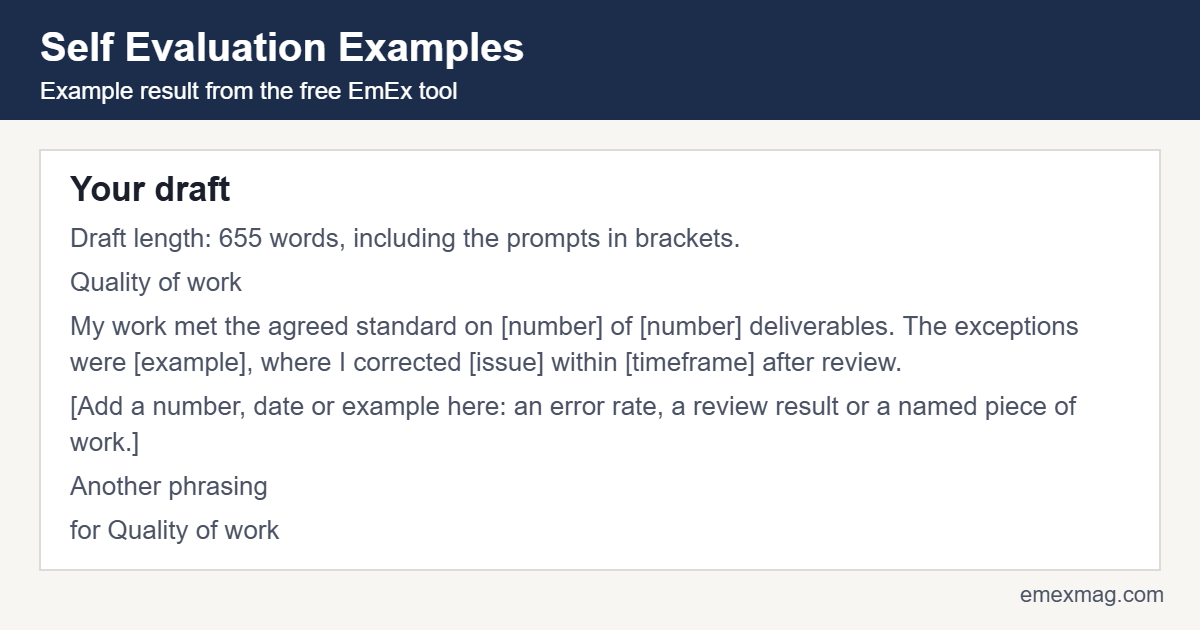
Use these self evaluation examples to draft your own statements, then edit them so they describe your real work.
Looking after your team: find a team experience
Looking for something different for your team? The EmEx Something Different directory lists unusual team experiences from UK and US suppliers. You contact the supplier direct, with no fees or commission.