The software changed. The shift didn’t.
Former CQC Registered Manager Mafalda Carvalho on what a care software rollout taught her about technology and AI adoption, and six practices that help frontline teams use new tools.

Why technology and AI adoption fails on the frontline, and how to make it work
Some years ago, I was the CQC Registered Manager of a home care service. In England, that means I was the person legally accountable to the regulator for the quality and safety of the care we provided.
During that time, the company switched from one care management system to another. On paper it was a routine upgrade. In practice, it taught me more about technology adoption than any strategy document.
Training was not included, because it cost extra. To keep costs down, the director asked us to watch YouTube videos and learn the new system independently.
Our care workers were handed a new app and expected to carry on. Many did not know how to use it, and when something went wrong, they did not know what to do. They were learning on their phones, between visits, while people depended on them for care. And I was accountable for the quality of that care, while the tool at the centre of it had been left to self-teaching.
The software was not the failure. The implementation decision was. And I now see the same decision being made with AI, in care and far beyond it.
The frontline trust gap
Research published this year shows that frontline workers are far less confident about new technology than their desk-based colleagues:
53% of knowledge workers vs 39% of frontline workers feel excited or hopeful about AI changing their work.
Source: Qualtrics, 2026 EX Trends Report
The same research found that people who use AI tools daily or weekly are 48 percentage points more hopeful than those who rarely or never use them. In other words, confidence follows experience. And frontline workers are the least likely to be given the time and support to build that experience.
That matters because much of the workforce does not sit at a desk. A care worker between visits, a retail assistant on the shop floor, a hotel housekeeper and a delivery driver all meet new technology in the same way: on a phone or handheld device, in the middle of a shift, with little time to stop and learn. What went wrong for us is a risk wherever work happens away from a desk.
Why organisations keep making the same decision
The incentive is easy to understand. The licence is a visible cost with a clear owner. Training, practice time and support are spread across teams and harder to justify, so they are the first things cut. When budgets are tight, that choice can look responsible.
But the cost does not disappear. It moves onto the frontline: into workers’ time, their stress and their confidence. It also moves onto managers. In my experience, the phone could start ringing before 7am with sickness, rota gaps and urgent concerns. That is the world new technology lands in. The manager expected to champion a new system is often the same person covering a shift.
What happens when nobody is equipped
From the first day, the problem was clear: none of us knew how to use the new system, and that included the office staff. When care workers got stuck, they phoned the office. But the people answering those calls were learning from the same videos and were just as unsure.
I remember one care worker in particular who struggled a great deal with it.
As the registered manager, I did my own independent research to work out how the system worked. It was never enough. There were many functions we simply never learned to use. The company had paid for a system, and we were only using part of it.
When people are not equipped, low usage is easy to mistake for resistance. Before blaming motivation, I now ask a different question: did this person have the clarity, time, resources and skills to do what we asked? For us, the honest answer was no, at every level, not only on the frontline.
Why AI raises the stakes
AI makes this lesson more urgent, not less. Our care app mostly recorded what people did. AI tools can suggest what to write, summarise what happened or recommend what to do next, and they can sound confident even when they are wrong. Frontline workers need to know when to rely on an output, when to question it and who to tell.
If leaders do not set clear rules on which tools are approved, what information can be entered and who is accountable for the output, staff will create their own rules through trial and error. In sectors that handle personal information, that is a real risk, not a communication problem.
The trade-off leaders have to own
Saving money on training is often a genuine attempt to protect a stretched budget. I understand that pressure. But learning alone from generic videos cannot teach people how a system fits their own workflows, their own customers or clients, and their own escalation routes.
None of this means every rollout needs a large training budget. It means adoption must be costed honestly. Cutting training may save money on the purchase order, but it creates hidden costs: lost time, errors, frustrated staff and managers pulled away from their core work. A leader who chooses to cut it should do so knowing where that cost will land.
How to make adoption work on the frontline
I think of this as the human implementation layer: the space between a sound decision and what people can actually do on a Tuesday morning. Looking back, our rollout broke down at almost every stage.
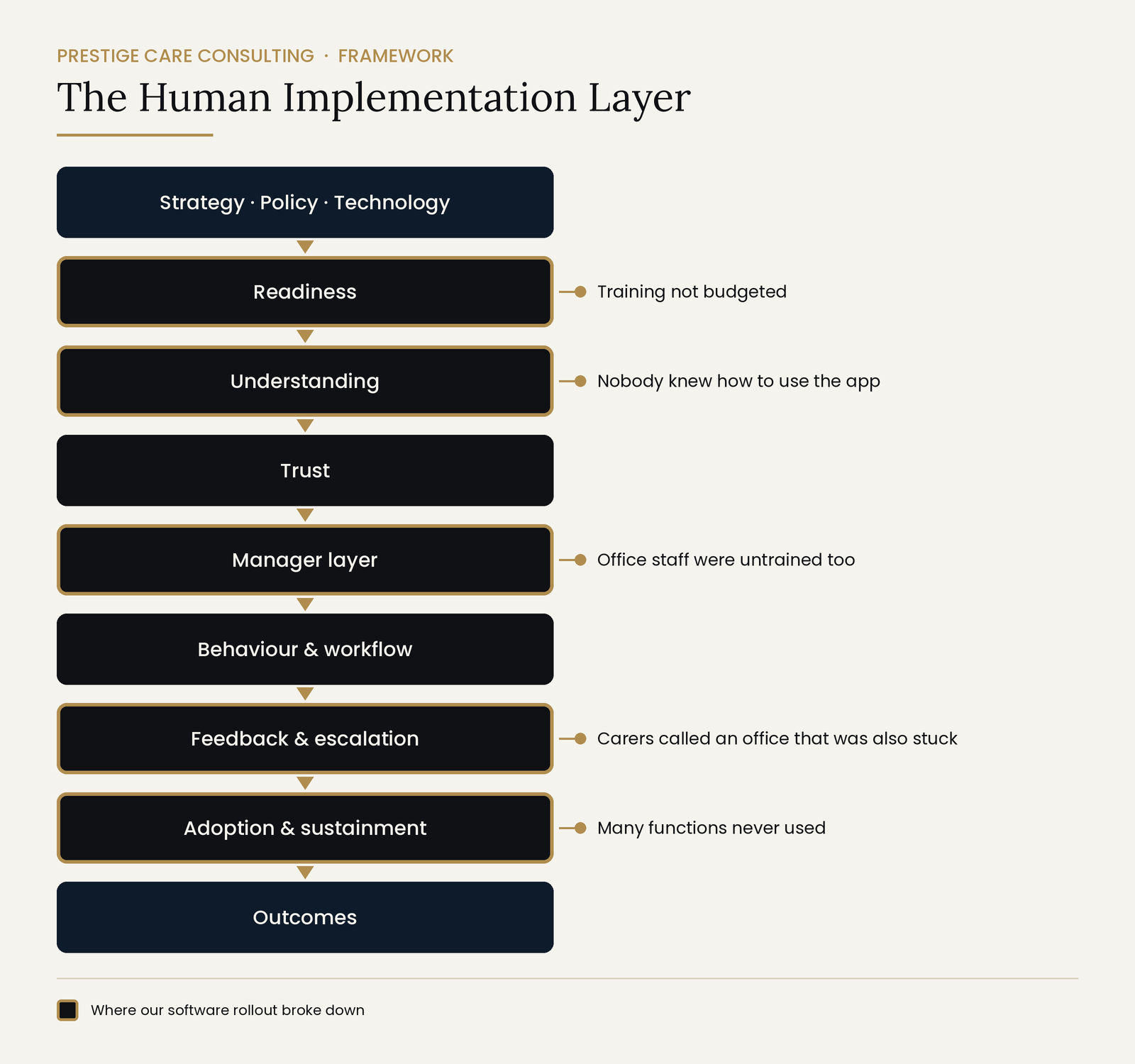
Six practices would have changed our experience, and they apply in any sector with a dispersed workforce:
- Budget for adoption, not just the licence. Training, practice time and support belong in the business case from the start.
- Build learning into the shift, not on top of it. Frontline staff cannot join an 11am update call. Use short, paid, protected sessions at handovers or the start of shifts, and let people practise on real tasks before go-live.
- Check digital access before you assume it. Not everyone has a reliable phone, enough data, good signal or the same confidence with apps. Find out first, and plan alternatives for those who need them.
- Equip managers and appoint local champions. Train supervisors and office teams before go-live, not alongside everyone else. Choose trusted peers on each shift or site who can answer questions in the moment, and give them time to do it.
- Make it safe to say “I don’t understand”. People will only admit confusion, report mistakes or challenge an AI output if they will not be blamed for it. That depends on managers who respond with help, not judgement.
- Give every worker a clear escalation route, and act on what comes back. A quick way to report problems only works if people can see that someone fixes them.
Measure adoption, not deployment
Logins and completion rates show that a system is switched on. They do not show that it is working. A system can be fully paid for and only partly used. Leaders should ask not just whether people log in, but how much of the system they can actually use, how confident staff feel, how many workarounds remain, how long tasks now take, and whether errors and escalations are rising or falling.
Technology, including AI, can make frontline work easier. But only if the people using it are treated as part of the investment.
Saving money on training doesn’t remove the cost. It just moves it onto your frontline.
Source: Qualtrics, “Improving AI Adoption Among Frontline Workers”, 2026 EX Trends Report, published June 2026.
Mafalda Carvalho is a former CQC Registered Manager, the founder of Prestige Care Consulting and the author of The Prestige Leader: The Human Side of Healthcare Leadership. Her work focuses on the human implementation layer: the gap between a sound strategy, policy or technology and what people can actually understand, trust, adopt and sustain in everyday work.
Related Articles
-

Why Culture Budgets Are Moving from Perks to Performance
TeamBonding founder David Goldstein on how to give culture budgets a purpose this fall, from choosing what teams need to practice to measuring what changes afterward.
3–5 minutes -
Is time running out for the employee engagement survey?
Employee engagement surveys have dominated HR for decades. Culture15 founder Charlie Coode argues behaviour may be a better measure for the AI era.
5–7 minutes -

Work Beyond Walls – Enough with the return-to-office debate; what if we ran a live experiment?
Work Beyond Walls turns Newcastle’s Boiler Shop into a live workplace experiment, asking what makes an office worth the journey.
3–5 minutes
Most Read
Get it in your inbox
The EMEX weekly newsletter — insight for HR leaders every Thursday.
Advertisement