PTO Accrual Calculator
This PTO accrual calculator turns a yearly paid time off allowance into the hours earned each pay period and for each hour worked. It also works as a vacation accrual calculator, because the math is the same. It shows the working for every answer. Nothing you enter leaves this page.
PTO accrual calculator by hours worked
Some policies set the PTO accrual rate against hours worked, for example 1 hour of PTO for every 30 or 40 hours worked. Enter the rate to see what it adds up to per week, per pay period and per year.
PTO calculator for a balance on a future date
Use this PTO calculator to see how many hours you will have on a future date, for example before a planned vacation or at the end of the year.
Payout value of a PTO balance
Enter a balance and an hourly rate to see the gross value before taxes and other withholding. Whether an employer has to pay out unused PTO depends on state law and on the employer’s policy.
How to calculate PTO accrual
Every method comes down to three steps.
- Turn the yearly allowance into hours. Multiply days by the hours in a workday.
- For accrual per pay period, divide the yearly hours by the number of pay periods: 52 for weekly, 26 for biweekly, 24 for semimonthly and 12 for monthly.
- For accrual per hour worked, divide the yearly hours by the hours worked in a year. A 40-hour week gives 40 × 52 = 2,080 hours.
Worked example
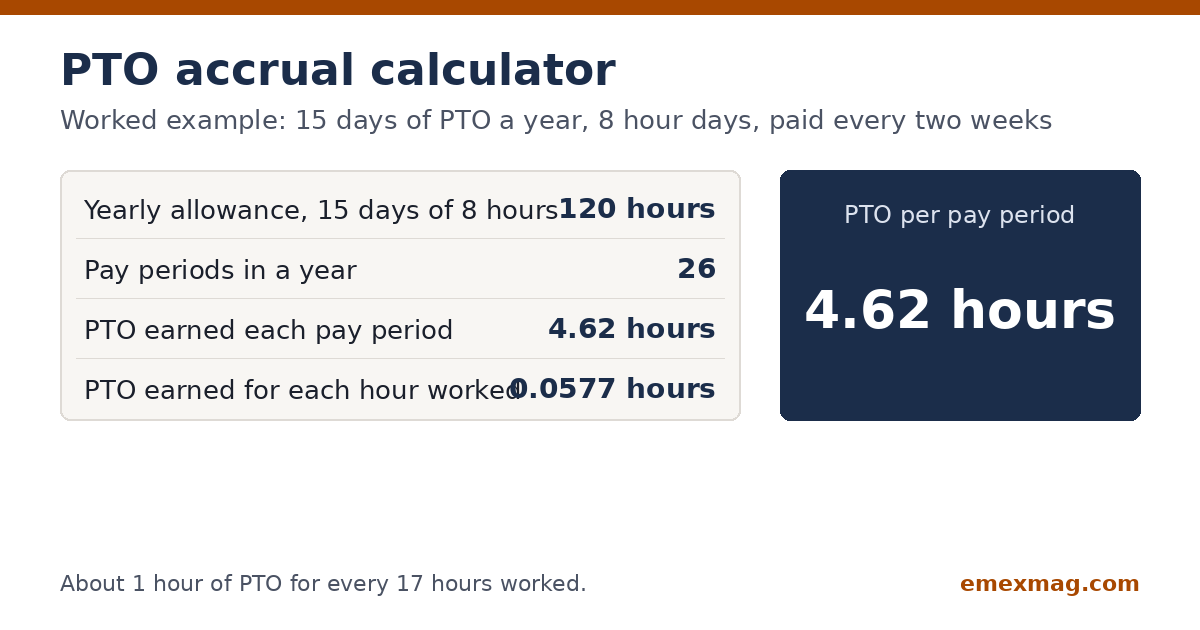
An employee gets 15 days of PTO a year, works 8-hour days and 40 hours a week, and is paid biweekly.
- 15 days × 8 hours = 120 hours a year.
- 120 ÷ 26 pay periods = 4.62 hours per pay period.
- 120 ÷ 2,080 hours worked = 0.0577 hours of PTO per hour worked. That is 1 hour of PTO for every 17.33 hours worked.
- A part-time employee on 20 hours a week gets half the allowance under proration: 120 × 20 ÷ 40 = 60 hours a year, or 2.31 hours per pay period.
- From January 1, 2027 to June 30, 2027 there are 12 biweekly pay periods. Starting with 20 hours, the employee earns 12 × 4.62 = 55.44 hours. After 40 hours of planned time off the balance is 20 + 55.44 − 40 = 35.44 hours.
- At $25 an hour, 35.44 hours has a gross payout value of $886.00.
The calculators above open with these numbers, so you can check each step.
What the law says
This page shows general math. Federal rules are described here and state rules can differ. The US Department of Labor says the Fair Labor Standards Act (FLSA) does not require payment for time not worked, such as vacations, and that these benefits are a matter of agreement between an employer and an employee. See the Department of Labor page on vacation leave.
That leaves accrual, carryover and payout to state law and to the employer’s written policy. California is one example of a state with its own rules. The California Labor Commissioner’s Office says employers there do not have to offer vacation, but where they do, earned vacation counts as wages, a “use it or lose it” policy is not allowed, a reasonable cap on accrual is allowed, and unused earned vacation must be paid at the final rate of pay when employment ends. See the California vacation FAQ. Check your own state labor agency and your employee handbook before you rely on a figure. This page is general information and not legal advice.
Questions about PTO accrual
How do I calculate PTO accrual per pay period?
Convert the yearly allowance to hours, then divide by the number of pay periods in the year. For 15 days of PTO at 8 hours a day, that is 120 hours. Paid biweekly, 120 divided by 26 is 4.62 hours per pay period. Paid semimonthly, 120 divided by 24 is 5 hours. The PTO accrual calculator on this page does this for weekly, biweekly, semimonthly and monthly pay.
How many hours of PTO do I earn per hour worked?
Divide the yearly PTO hours by the hours worked in a year. A full-time year at 40 hours a week is 2,080 hours. With 120 hours of PTO, that is 120 divided by 2,080, or 0.0577 hours of PTO per hour worked. Put another way, it is 1 hour of PTO for every 17.33 hours worked.
How much PTO is 1 hour for every 30 hours worked?
At 40 hours a week, 1 hour of PTO for every 30 hours worked gives 1.33 hours a week, 2.67 hours per biweekly pay period and 69.33 hours a year. At 1 hour for every 40 hours worked, the same schedule earns 1 hour a week and 52 hours a year.
How is PTO prorated for part-time employees?
A common method is to multiply the full-time allowance by the employee’s weekly hours divided by full-time weekly hours. With a full-time allowance of 120 hours and a 40-hour full-time week, an employee on 20 hours a week gets 60 hours a year. Your employer’s policy may use a different method.
Does federal law require paid vacation or PTO?
No. The US Department of Labor says the Fair Labor Standards Act does not require payment for time not worked, such as vacations. Paid time off is a matter of agreement between an employer and an employee. State law and the employer’s policy govern accrual, carryover and payout.
Does unused PTO have to be paid out when I leave a job?
It depends on the state and the employer’s policy. Federal law does not require it. Some states have their own rules. In California, for example, the Labor Commissioner’s Office says earned and unused vacation must be paid at the final rate of pay when employment ends. To estimate the gross value, multiply the balance in hours by the hourly rate: 35.44 hours at $25 an hour is $886.00.
Related tools
Use this PTO accrual calculator to turn a yearly PTO allowance into hours per pay period or per hour worked. It also projects a future balance and values a payout.