Exit Interview Questions: 107 Questions and a Guide Builder

Exit Interview Questions: Build Your Interview Guide
This page lists 107 exit interview questions in 10 themes and builds them into a guide you can use today. Choose the themes, the length and the format. The builder puts the questions in a sensible order, adds an opening script and a closing script, and lets you reorder, copy and print the result. Every question is also listed further down, with 29 stay interview questions to ask before anyone resigns.
Nothing you choose here is stored or sent anywhere. The guide lasts until you close or reload the page.
How the exit interview template is put together
The builder works as an exit interview template that you fill by ticking boxes. It takes core questions first, one theme at a time, and only adds optional questions when there is room. The order of the finished guide follows the order a conversation naturally takes: the decision to leave, the job, the manager, the team, pay, workload, tools, what might have changed the outcome, the new job, and advice.
- Conversation: 5 questions in 15 minutes, 10 in 30 minutes and 15 in 45 minutes. That is two to three minutes per answer, with a few minutes kept for the opening and the close.
- Written survey: 8 questions for 15 minutes, 15 for 30 minutes and 22 for 45 minutes, at about two minutes per written answer. Shorter surveys are more likely to be finished.
- Core and optional: 25 questions are marked core. These are the best exit interview questions to keep the same for every leaver, so that answers can be compared. Optional questions go deeper on one theme.
- Interview, survey or both: 98 questions suit a conversation and 72 suit a written survey. Questions marked “Interview” depend on a follow-up, so they are left out of surveys. Questions marked “Survey” ask for a rating or a choice, so they are left out of conversations.
If you choose more themes than a short guide has room for, the builder covers the themes that matter most first: the reason for leaving, what would have changed the person’s mind, the manager, the role, and advice.
Worked example
Leave all 10 themes ticked, choose “30 minutes” and “Conversation”, and select “Build my guide”. The guide has 10 questions, one core question from each theme. It opens with “What is the main reason you decided to leave?” and ends with “What is one thing we should change to make this a better place to work?”. Change the length to 15 minutes and the guide drops to 5 questions, with a note that 5 of your themes are not covered.
Running an exit interview that tells you something
Who should run it
Someone outside the leaver’s reporting line: a member of the HR or people team, or a trained manager from another department. The line manager should not run it. The manager is often part of the reason, and may also write the reference, so the leaver will be careful about what they say. In a small organization with no HR team, ask a senior person from a different team or an outside adviser.
The line manager should still have their own goodbye conversation. That one is about handover and thanks, and it does not replace the exit interview.
Hold the interview in the last week or two of the notice period, and not on the final day. Offer the choice of a conversation, a written exit survey or both. Some people say more in writing, and some only say it out loud.
Confidentiality, and how far you can honestly promise it
Do not promise that the conversation is confidential or anonymous. In a team of four with one leaver this quarter, everyone will know who said what. Say what is true instead:
- who will see the notes, by role;
- that comments are combined with those of other leavers before managers see them, where there are enough leavers to do that;
- that you will ask before you quote anything that could identify the person;
- that there is a limit: a report of bullying, harassment, discrimination or something unsafe or unlawful may have to be passed on and acted on.
The opening script in the builder says all four. Write your notes as if the leaver may read them later, and keep them under your organization’s normal rules for employee records.
What to do with what you hear
Write up the notes on the same day. Record the main reason and up to two contributing reasons, using the same short list of reasons every time. The 10 themes on this page work as that list. Record separately whether the leaver thought the departure could have been prevented, and what would have prevented it.
Pass on anything that needs action now, such as a broken process or a handover gap, without waiting for a quarterly report. Tell the leaver’s manager the themes, and leave out the wording that would identify the source unless the leaver has agreed.
Spotting themes across leavers
One exit interview is one person’s account. The value comes from reading them together. Every quarter, count the main reasons and look at them by team, by length of service and by role, as long as each group is large enough that no one can be picked out. Look at people who leave in their first year separately, because those departures often say more about hiring and onboarding than about the job.
Compare what leavers say with what your engagement survey and stay interviews say. If leavers name workload and current employees do not, ask whether current employees feel able to say it. Report to leaders in two columns: what we heard, and what we are doing about it. People stop giving honest answers when nothing changes afterward.
If someone discloses bullying, harassment or discrimination
Stop working through the guide. Listen, and thank the person for telling you. Do not promise to keep it secret, and do not give a view on whether it happened. Write down what they say in their own words, ask what they would like to happen, and explain what you have to do next and who you will tell.
The person leaving does not end the matter. Other employees may still be affected, and your organization’s own policy and its legal duties apply. Follow your policy on complaints and tell the person named in it, usually the head of HR, on the same day.
- United States: the Equal Employment Opportunity Commission explains when harassment is unlawful under federal law and when an employer is liable. For harassment by coworkers or non-employees, an employer is liable if it knew, or should have known, about the harassment and failed to take prompt and appropriate corrective action. See EEOC: Harassment. State and local rules can differ.
- United Kingdom: Acas advises employers to take any bullying or discrimination complaint seriously and look into it as soon as possible, including a complaint made a long time after the incident. See Acas: handling a bullying, harassment or discrimination complaint and Acas: discrimination and the Equality Act 2010.
This section is general information and not legal advice. For a specific case, speak to your HR lead or an employment lawyer.
107 good exit interview questions, by theme
The full list of exit interview questions to ask, with exit survey questions marked. Each question is tagged as core or optional, and as suited to an interview, a survey or both. Great exit interview questions ask about something the organization can change and invite an example, so each one here is written to do that. The builder above draws from these same lists.
Exit interview questions about the reason for leaving
Start here. The first reason people give is usually the one that is easiest to say, so ask about timing and triggers as well.
- What is the main reason you decided to leave? Core · Interview or survey
- When did you first start thinking about leaving, and what was happening at the time? Core · Interview
- Was there one event that turned thinking about leaving into a decision? Core · Interview or survey
- Before you started looking, what kept you here? Optional · Interview
- Which of these played a part in your decision: the work itself, your manager, pay, progression, workload, the team, flexibility, or something else? Optional · Survey
- Did you go looking for another job, or did this one find you? Optional · Interview or survey
- If you raised concerns before you resigned, what was done about them? Core · Interview or survey
- If you had concerns that you did not raise, what stopped you? Optional · Interview
- Did anything change in the past year that made staying less appealing? Optional · Interview or survey
Questions about the role
How the job compared with what was promised, and what the next person in it should know.
- How closely did the job match what you were told when you were hired? Core · Interview or survey
- Which parts of the role did you enjoy most? Core · Interview or survey
- Which parts would you have handed to someone else if you could? Core · Interview or survey
- What did you spend time on that you think added little? Optional · Interview
- Did you have a clear picture of what good performance looked like in your role? Optional · Interview or survey
- How well did the role use your skills? Optional · Interview or survey
- Which decisions did you want to make yourself but had to get approved? Optional · Interview
- If your responsibilities changed while you were here, how was the change agreed with you? Optional · Interview or survey
- Where did your role overlap or collide with someone else’s? Optional · Interview
- Did you understand how your work connected to what the organization was trying to achieve? Optional · Interview or survey
- If we redesigned this role, what would you change first? Optional · Interview
Questions about the manager
Ask for examples. "She was fine" tells you nothing, and one specific story tells you a lot.
- How would you describe your working relationship with your manager? Core · Interview or survey
- How useful was the feedback you got on your work? Core · Interview or survey
- What did your manager do that you would want every manager here to do? Core · Interview
- What do you wish your manager had done differently? Core · Interview
- How useful were your one-on-one meetings with your manager? Optional · Interview or survey
- Did your manager follow through on what they said they would do? Optional · Interview or survey
- Did you feel able to disagree with your manager? Optional · Interview or survey
- When you made a mistake, how was it handled? Optional · Interview
- Did your manager talk with you about your development outside the annual review? Optional · Interview or survey
- My manager treated people on the team fairly. (Agree, neutral or disagree, with space for a comment.) Optional · Survey
- How did your manager handle changes in priorities from higher up? Optional · Interview
- Did you know where you stood with your manager on performance? Optional · Interview or survey
- How did your manager react when you resigned? Optional · Interview
Questions about team and culture
What it was like to work here day to day, as opposed to what the values statement says.
- How would you describe the culture here to a friend who was thinking of applying? Core · Interview or survey
- Did you feel you belonged on your team? Core · Interview or survey
- Is there anything about how people are treated here that we should know about? Core · Interview
- How well did your team work together under pressure? Optional · Interview or survey
- Were people comfortable saying when something was going wrong? Optional · Interview or survey
- What behavior gets rewarded here, whatever the values say? Optional · Interview
- What gets tolerated here that should not be? Optional · Interview
- How well did other teams cooperate with yours? Optional · Interview or survey
- Did you trust what senior leaders told you? Optional · Interview or survey
- How were decisions that affected you communicated? Optional · Interview or survey
- I would feel comfortable raising a concern with someone senior. (Agree, neutral or disagree, with space for a comment.) Optional · Survey
Questions about pay and progression
Pay is often named as the reason because it is a safe answer. Ask whether it was the reason or one factor among several.
- Did you feel your pay was fair for the work you did? Core · Interview or survey
- Could you see a next step for yourself here? Core · Interview or survey
- How well did you understand how pay decisions were made? Optional · Interview or survey
- Was pay the reason you left, or one factor among several? Optional · Interview or survey
- If you asked about a pay increase or a promotion, what answer did you get? Optional · Interview
- Which of our benefits mattered most to you, if any? Optional · Interview or survey
- Did anyone tell you what you would need to show to move up? Optional · Interview
- Did you have the chance to learn new skills in the past year? Optional · Interview or survey
- How fair did promotion decisions here seem to you? Optional · Interview
- How would you rate the opportunities for career development here? Optional · Survey
- If you applied for an internal role, what was that experience like? Optional · Interview or survey
- What kind of recognition meant something to you, and how often did you get it? Optional · Interview
Questions about workload and wellbeing
Keep these about the job: hours, pressure, flexibility and support. Do not ask about a person’s health or home life. If they choose to tell you, listen.
- Was your workload manageable in a typical week? Core · Interview or survey
- Were you able to switch off from work outside your working hours? Core · Interview or survey
- How often were you expected to work beyond your contracted hours? Optional · Interview or survey
- When the workload was too high, who did you tell and what happened? Optional · Interview
- Did you have the flexibility you needed over where and when you worked? Optional · Interview or survey
- Were you able to take your time off without work piling up or following you? Optional · Interview or survey
- What made the busy periods harder than they needed to be? Optional · Interview
- Was the team staffed for the amount of work it was given? Optional · Interview or survey
- How much say did you have in setting your deadlines? Optional · Interview
- I could raise concerns about my workload without it counting against me. (Agree, neutral or disagree, with space for a comment.) Optional · Survey
- Were priorities clear enough for you to know what could wait? Optional · Interview or survey
- How useful was the support on offer when work got difficult? Optional · Interview
- How did the pressure of the job change during your time here? Optional · Interview or survey
Questions about onboarding and tools
Most useful with people who leave in their first year or two, and for capturing what the leaver knows before they go.
- Did you have the tools, systems and information you needed to do your job? Core · Interview or survey
- How well did your first few weeks prepare you for the job? Optional · Interview or survey
- What did you have to work out for yourself that someone could have told you? Optional · Interview or survey
- Which system or process wasted the most of your time? Optional · Interview
- Was the training you received useful? Optional · Interview or survey
- How long did it take before you felt confident in the role? Optional · Interview or survey
- Who helped you most when you were new? Optional · Interview
- What workaround have you built that the next person will need to know about? Optional · Interview
- Were processes written down, or did you rely on asking people? Optional · Interview or survey
- How would you rate the equipment and software you were given? Optional · Survey
- What would you add to the first month for a new hire on this team? Optional · Interview
- When something broke or you got stuck, how easy was it to get help? Optional · Interview or survey
Questions about what would have changed their mind
These questions show whether the departure was preventable, which leaders often want to know.
- Was there anything we could have done that would have kept you here? Core · Interview or survey
- If something could have kept you, how early would it have needed to happen? Core · Interview
- If you were offered something to stay, why did it not change your mind? Optional · Interview or survey
- Would a different role or team here have interested you? Optional · Interview or survey
- Did anyone ask you what it would take to keep you before you resigned? Optional · Interview
- What would need to be different for you to consider coming back in the future? Optional · Interview or survey
- Which one change would have been most likely to keep you: pay, role, manager, workload, flexibility, progression, or nothing? Optional · Survey
- Was there a conversation you were waiting for that never happened? Optional · Interview
- Was a promise made to you that was not kept? Optional · Interview or survey
Questions about the new job
The leaver does not have to name the employer or share figures. Say so before you ask.
- What does your new role offer that this one did not? Core · Interview or survey
- Is the new role a step up, a sideways move or a change of direction? Optional · Interview or survey
- How does the new package compare overall? You do not need to share figures. Optional · Interview or survey
- What did the new employer do in their hiring process that impressed you? Optional · Interview
- How do the working arrangements compare, such as hours, location and flexibility? Optional · Interview or survey
- If you are moving to another employer, what was the biggest draw: pay, role, progression, flexibility, culture or location? Optional · Survey
- What did they tell you about how they develop people? Optional · Interview
- Did anything about how they described their culture stand out against ours? Optional · Interview
Questions asking for advice
End here. Many people find it easier to give advice than criticism, and the answers are often the most direct of the whole conversation.
- What is one thing we should change to make this a better place to work? Core · Interview or survey
- What should we make sure we keep doing? Core · Interview or survey
- What would you tell the person who takes over your role? Core · Interview
- What advice would you give the senior leadership team? Optional · Interview or survey
- Is there anything senior leaders seem not to know about working here? Optional · Interview
- What do we do better than other places you have worked? Optional · Interview or survey
- What do other places you have worked do better than us? Optional · Interview or survey
- Is there anything else you would like us to know? Optional · Interview or survey
- How likely are you to recommend this organization to a friend as a place to work, from 0 to 10, and why? Optional · Survey
29 stay interview questions to ask before people resign
An exit interview tells you why one person left, after the point where you could do anything about it for them. A stay interview asks the same things of people who are still here. The answers are more useful for three reasons: you can act on them for the person who gave them, the person has less reason to be guarded than someone protecting a reference, and you hear from people who would never have reached an exit interview because they were going to leave quietly.
Unlike an exit interview, a stay interview is best run by the line manager, one to one, once or twice a year and apart from the performance review. Ask five or six of these, listen more than you talk, and come back within two weeks to say what you can and cannot change.
- What part of your job would you miss most if it were taken away?
- What are you learning at the moment, and what would you like to be learning?
- Which of your skills are we not using?
- What would you like to do more of in the next six months?
- What would you like to do less of?
- When did you last have a really good day at work, and what made it good?
- When did you last think about leaving, and what prompted it?
- If a recruiter called tomorrow, what would they need to offer for you to take the call seriously?
- What keeps you here?
- Do you feel your work is noticed? By whom?
- How do you like to be recognized for good work?
- What is one thing I could do differently as your manager that would make your job easier?
- What am I doing that you would like me to keep doing?
- Do you have the flexibility you need at the moment?
- Is your workload sustainable for the next six months as things stand?
- What gets in the way of doing your best work?
- Which process or meeting would you drop if it were up to you?
- Where would you like to be in two years, and can you see a route to that here?
- Is there a role or project elsewhere in the organization that interests you?
- Do you feel your pay is fair for what you do? What makes you say that?
- Do you know what you would need to show to reach the next level?
- Who on the team do you work best with, and what makes that work?
- Is there anything about how the team works together that wears you down?
- Have we made any promises to you that we have not kept?
- What has changed here in the past year, for better or worse?
- How confident are you in where the organization is heading?
- Is there anything you are waiting for a decision on, from me or from the organization?
- What would you tell a friend who asked what it is like to work here?
- What should I have asked you that I did not?
Questions about exit interviews
What are good exit interview questions to ask?
Good exit interview questions are open, specific and about things the organization can change. Three from this page are "When did you first start thinking about leaving, and what was happening at the time?", "If you raised concerns before you resigned, what was done about them?" and "Was there anything we could have done that would have kept you here?". This page lists 107 questions in 10 themes, and 25 of them are marked as core.
How many questions should an exit interview have?
Fewer than most templates suggest. The builder on this page allows two to three minutes per answer in a conversation, which gives 5 questions for 15 minutes, 10 for 30 minutes and 15 for 45 minutes, with time kept for the opening and the close. A written exit survey can carry a few more: 8, 15 or 22 questions for the same three lengths.
Who should conduct an exit interview?
Someone outside the leaver’s reporting line, such as an HR or people team member, or a trained manager from another department. The line manager should not run it, because the manager is often part of the reason for leaving and may also be the person who writes the reference.
Are exit interviews confidential?
Only up to a point, and the interviewer should say so at the start. You can tell the leaver who will see the notes, and whether comments are combined with those of other leavers before managers see them. You cannot promise secrecy if the leaver reports bullying, harassment, discrimination or something unsafe or unlawful, because the organization may have to act on it.
Is an exit survey better than an exit interview?
They do different jobs. Exit survey questions give answers you can count and compare across leavers, and some people are more candid in writing. A conversation lets you ask a follow-up, which is where the real reason usually comes out. Many organizations send a short survey to every leaver and hold a conversation as well where they can.
What is the difference between an exit interview and a stay interview?
An exit interview asks someone who has already resigned why they are leaving. A stay interview asks a current employee what keeps them and what might make them leave, while there is still time to act on the answer. This page includes 29 stay interview questions.
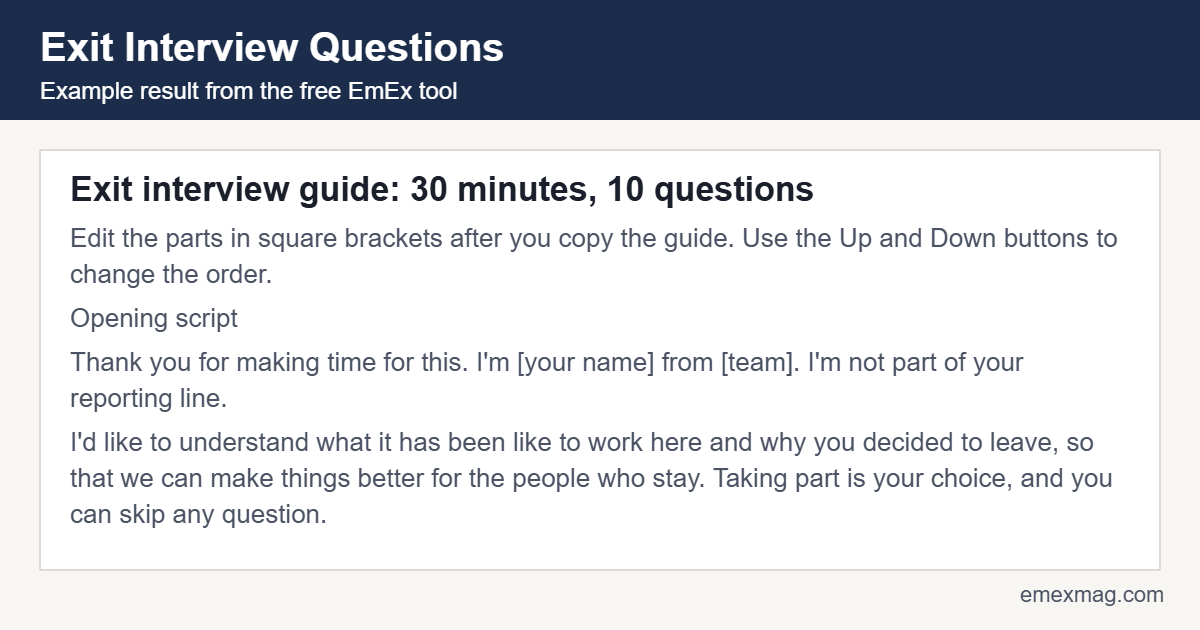
Use these exit interview questions to plan a leaver conversation that gives you useful answers.
Looking after your team: find a team experience
Looking for something different for your team? The EmEx Something Different directory lists unusual team experiences from UK and US suppliers. You contact the supplier direct, with no fees or commission.