How AI is Changing Hiring, and What Candidates Should Know?
AI is changing hiring in three ways. It automates how applications are sorted and screened, it pushes hiring decisions toward skills, and it adds AI-assisted steps to the interview process. AI now sits on both sides of the hiring table: most employers use AI tools to sort applications, and most job seekers use them to…

AI is changing hiring in three ways. It automates how applications are sorted and screened, it pushes hiring decisions toward skills, and it adds AI-assisted steps to the interview process. AI now sits on both sides of the hiring table: most employers use AI tools to sort applications, and most job seekers use them to write those applications. The result is a hiring process that moves faster but trusts itself less, which makes human oversight more important, not less.
In a 2026 survey of US hiring managers, 87% said they use AI in at least one stage of recruitment. Among US job seekers surveyed by Clutch, 80% use AI during their search. Both sides have embraced the same technology, and each is a little worried about how the other uses it.
That changes how people are sourced, screened, assessed and matched to roles. It also changes what gets rewarded. Here is what is actually happening, and what to do about it if you are hiring or trying to get hired.
The EmEx newsletter
Get one practical EX read every Wednesday
Join the HR and employee experience leaders who read EmEx each week. It is free, and you can unsubscribe at any time.
Where AI tools show up in hiring today?
The most common use of AI in recruitment is also the least visible: screening applicants. In Resume Genius’s 2026 report, 58% of hiring managers use AI to review resumes and applications, while only 18% use AI-assisted video interviews. For most HR teams, AI is a sorting tool, not a decision-maker.
That sorting still matters. Your application may be ranked, filtered or flagged before a person reads it, and candidates know it: 77% of job seekers in Clutch’s survey believed employers used AI to screen their applications.
In practice, AI recruitment tools appear at four points in the recruitment process:
• Sourcing: searching candidate profiles and databases to find passive candidates who match the job requirements, often before job postings go live.
• Screening: applicant tracking systems that use natural language processing to parse your CV, pull out skills and rank you against the job description.
• Assessment: AI-scored tests, recorded video interviews and chat-based first rounds.
• Matching: platforms that recommend roles to candidates, and candidates to recruiters, based on skills rather than job titles.
AI also takes on administrative tasks such as interview scheduling and drafting job descriptions. That is where most of the efficiency gains come from.
Adoption is uneven. In Morgan McKinley’s Q3 2026 survey across seven markets, 36% of employers said they don’t use AI to hire at all. The UK was the most cautious, with more than half saying no, though that rests on a small sample. Regulation is rapidly evolving too: the EU AI Act classes AI systems used in recruitment as high-risk, which brings stricter rules on transparency and human oversight. If you apply across borders, expect very different processes.
What employers are really screening for?
AI screening works best on what it can match and verify, which is one reason hiring practices are shifting from credentials to skills. NACE’s Job Outlook 2026 found that 70% of employers use skills-based hiring, up from 65% a year earlier. Only 42% still screen by GPA, down from 73% in 2019. Machine learning and predictive analytics can help when evaluating candidates against job requirements, but only when the underlying workforce data is reliable.
This matches what we see on avua, where we hire across energy, construction, healthcare, life sciences, robotics and technology. The hardest roles to fill are rarely hard because of a missing degree. They need a specific, provable skill: a certification, a type of site experience, or knowledge of a particular system or regulation. Three of the slowest-to-fill roles on avua last quarter show the pattern:
• Battery storage (BESS) commissioning engineers: 74 days on average to fill. Only about 1 in 9 applicants had the high-voltage certification the role requires.
• Data centre electrical commissioning engineers: 68 days on average. Only 12% of applicants were shortlisted, mostly because they lacked hands-on experience with live critical-power systems.
• Clinical research associates with oncology trial experience: 61 days on average, even though applications were up about 30% on the previous quarter.
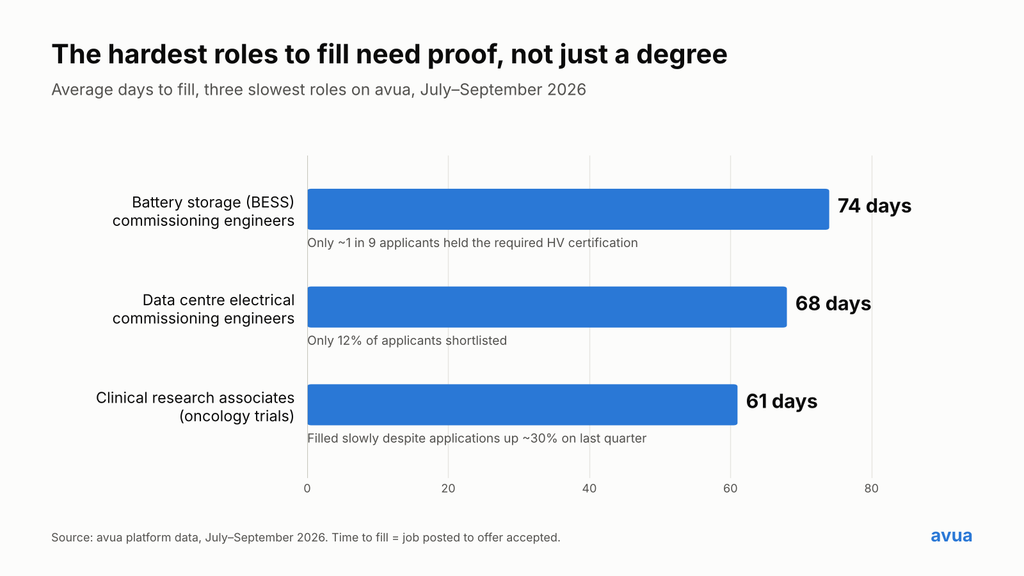
Source: avua platform data, July–September 2026. Time to fill is measured from the date a job is posted to the date an offer is accepted.
There is a catch. AI models learn from past hiring decisions, so they can inherit existing biases, including gender or racial bias, unless teams test for it and build in bias mitigation. Implementing AI well means checking what it filters out, not just what it lets through.
For candidates, the upside is that a clearly shown skill can outweigh a missing “standard” background. The downside is that vague claims count for less. “Strong project management experience” tells a screening tool nothing. “Delivered a 40 MW solar install six weeks early” tells it, and the hiring manager reading it, a great deal.
Candidates are using AI too, and it is backfiring at scale
Job seekers adopted AI quickly. In Clutch’s survey, 86% said AI helps them send more applications each week, and 94% tailor their CV for each role. Morgan McKinley found that 78% use generative AI when looking for work, mostly for CVs, cover letters and interview prep.
The problem is that everyone had the same idea. When every application is polished by the same tools, polish stops standing out. Of Clutch’s respondents, 93% worry AI-written applications make it harder for qualified candidates to be noticed.
Employers have noticed. In Resume Genius’s survey, 58% of hiring managers had received AI-generated CVs or cover letters, 46% had seen candidates use AI to answer interview questions, and 82% were concerned about it. Four in ten employers in Morgan McKinley’s survey said candidates’ AI use makes skills harder to verify.
So employers are adding checks: live conversations, practical tests and follow-up questions that a generic answer can’t get through. That is the arms race. More AI-assisted applications lead to closer scrutiny of each one, even as companies use AI automation elsewhere to boost recruiter efficiency.
1. Write for the screen first, then for the person: Use the exact names of skills, tools and certifications from the job ad, with plain headings and no key details hidden in tables or images. Then reread it as a human would: it still needs to read like you.
2. Prove it, don’t claim it: Swap adjectives for outcomes, with numbers, scale, dates and named systems. Evidence is the one thing a generic AI draft can’t invent for you.
3. Use AI as an editor, not an author: It’s useful for tightening wording, spotting gaps against job descriptions and checking how ATS-friendly your CV is. It’s risky when it writes claims you can’t defend in an interview.
4. Apply to fewer roles, better: A handful of well-matched applications usually beats dozens of generic ones.
5. Practice for the human round. Rehearse answers built on real examples. Mock interviews, with a friend or an AI mock interview tool, show whether your stories hold up when someone asks a follow-up question.
6. Know what you’re being assessed by: If a company uses AI-scored tests, video interviews or AI agents, ask how they work and where human recruiters review the results. The answer tells you a lot about the employer.
7. Keep your profile consistent: Recruiters and sourcing tools compare your CV with your LinkedIn profile. Mismatched dates or job titles raise more doubt now than they used to.
For all the automation, human recruiters still make the final call. In Morgan McKinley’s survey, only 5% of job seekers would accept a hiring decision made by AI alone, while 44% would accept one made by AI and a person together. Most employers seem to agree: AI handles the volume, while talent acquisition professionals and HR teams keep authority over hiring decisions.
That balance is also what makes AI’s promise to reduce bias believable. The promise only holds when teams are maintaining human oversight and checking outputs carefully.
For candidates, the lesson is simple. AI decides whether a person reads your application. Once they do, the old rules apply: specific evidence, honest claims and a clear reason why you fit the role. The recruiter role still rests on judgement and relationship building. The candidates doing best right now use AI to get noticed and their own judgement to get hired.
Related Articles
-

18 Corporate Team Building Activities That Work at Scale
Most corporate team building activities fail one of two tests. Either they fall apart past 30 people, or they can’t survive a question from finance or legal. This list is built for the people who answer both. Every one of these corporate team building activities works for a large company. Each has a clear business…
8–12 minutes -
How Well Do Your People Programs Work Together? A Free Strategy Assessment
A free four-minute Employee Experience Strategy Assessment for HR leaders, with 12 questions that show where a people strategy is strong, where it is thin and what to ask next.
5–7 minutes -

Team Bonding Activities London: 12 Ideas Beyond the Escape Room
Good team bonding is not a contest. It is people finding out that the quiet person in finance makes excellent bread, or that two colleagues grew up on the same street. That is why the best team bonding activities London teams book have one thing in common. They give people something to do together, with…
6–9 minutes
Most Read
Get it in your inbox
The EMEX weekly newsletter — insight for HR leaders every Thursday.
Advertisement