HR 2030: Josh Bersin on HR’s past and future
From shrinking labour markets and AI-powered employees to an HR function run by interconnected digital agents, Josh Bersin took us through the past, present and future of HR at UNLEASH in Paris.
A little public service announcement for anyone who missed Josh Bersin’s keynote at UNLEASH World in Paris: it was brilliant. As a media partner and fan of data-led storytelling, I wanted to share his main story. It’s HR’s past, present, and future. And no, not the HR version of A Christmas Carol. Here goes
First, the economic problem
Josh started with the economy, and specifically the contradiction between what we’re hearing about AI taking everyone’s jobs and what demographic data tells us is actually happening.
Across developed economies, working-age populations are ageing and, in some countries, shrinking. Birth rates are falling, people are retiring, and immigration is increasingly politically difficult.
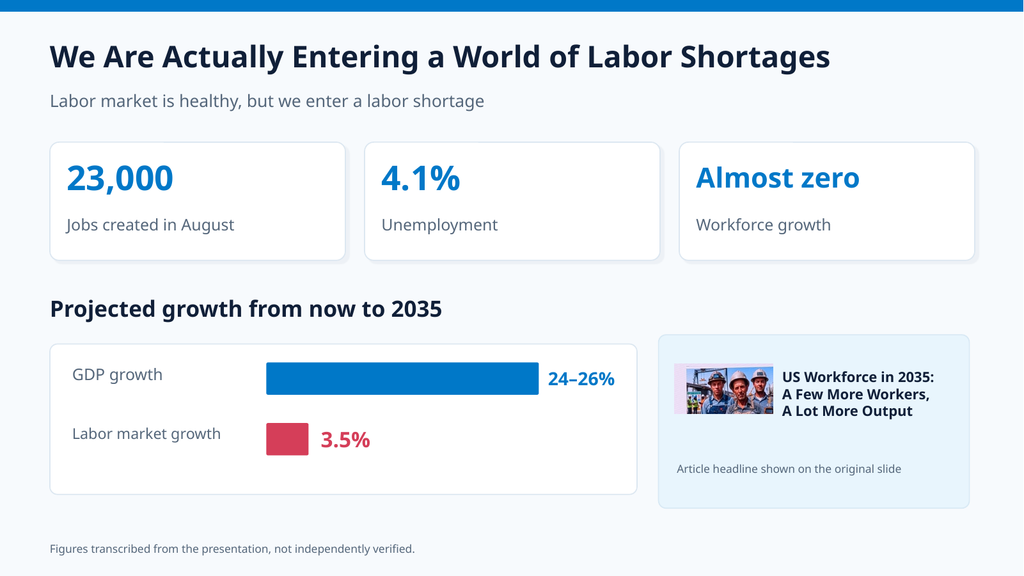
In the US, Josh pointed to forecasts suggesting labour-force growth of only around 3–3.5% in total over the next decade.
Meanwhile, the economy is still expected to grow. Even modest annual GDP growth compounds to something like 25–30% over ten years.
So where does all that extra economic output come from if we don’t have many more people to do the work?
Productivity. Better use of talent. And increasingly, AI. Josh’s argument was that we need to stop thinking about AI purely as a technology for cutting costs and eliminating jobs, because the much bigger opportunity is to help people and organizations produce more.
From a clever assistant to a digital workforce
Josh then moved on to the extraordinary amount of investment pouring into AI. He described investment on a scale comparable with some of the largest technological transformations in history, and acknowledged that we may well see a financial bubble burst along the way.
But regardless of what happens to valuations, the technology itself is moving very quickly. Think about how our understanding of generative AI has changed in just a few years. First, we thought it was an interesting novelty. Then it became an assistant, helping us write things, answer questions and analyse information.
Then we started talking about agents. Not just systems that give us answers, but technology that can take actions on our behalf.
And now we’re moving towards networks of agents, working together across different activities and systems.
Josh used the J-curve to explain where we are. I have recreated it for you here:
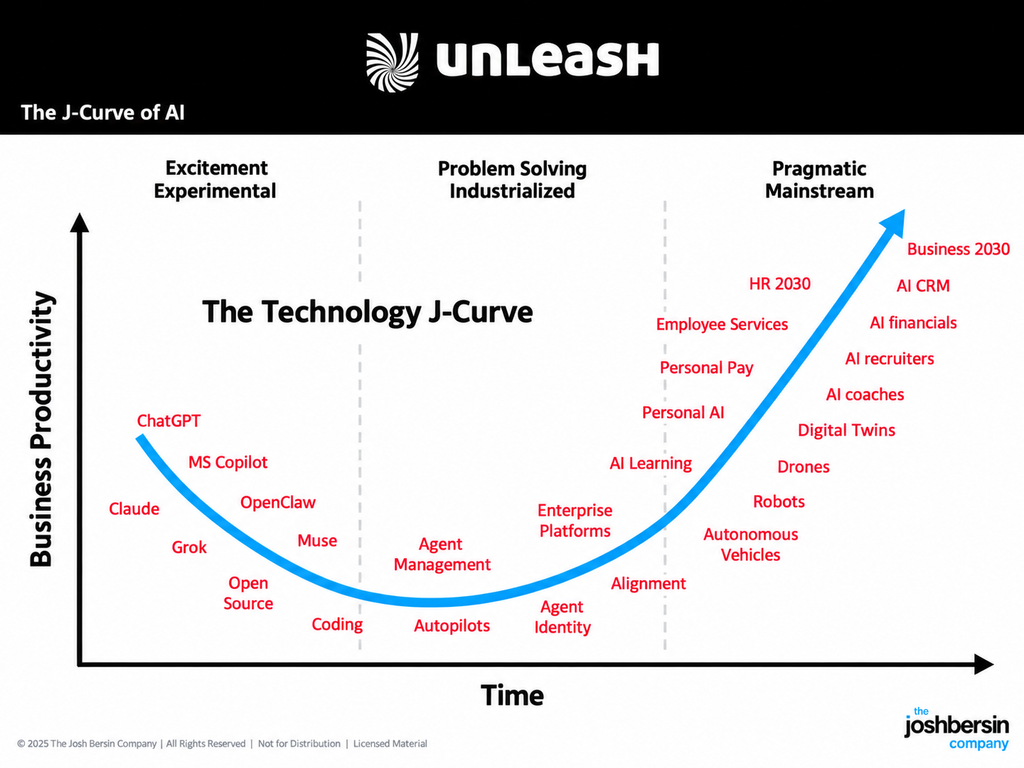
With major technological innovations, the first few years can actually make things harder. Organizations have to learn how the technology works, change processes, build capabilities and work through the inevitable problems.
Eventually, things start to improve, and the benefits accelerate. Josh believes we’re just beginning to move up that curve with AI.
He made quite a funny comment that last year there were plenty of ideas and predictions about agents. This year, everyone had one to sell, and having spent two days walking around the exhibition floor, he was right really.
How HR got so complicated
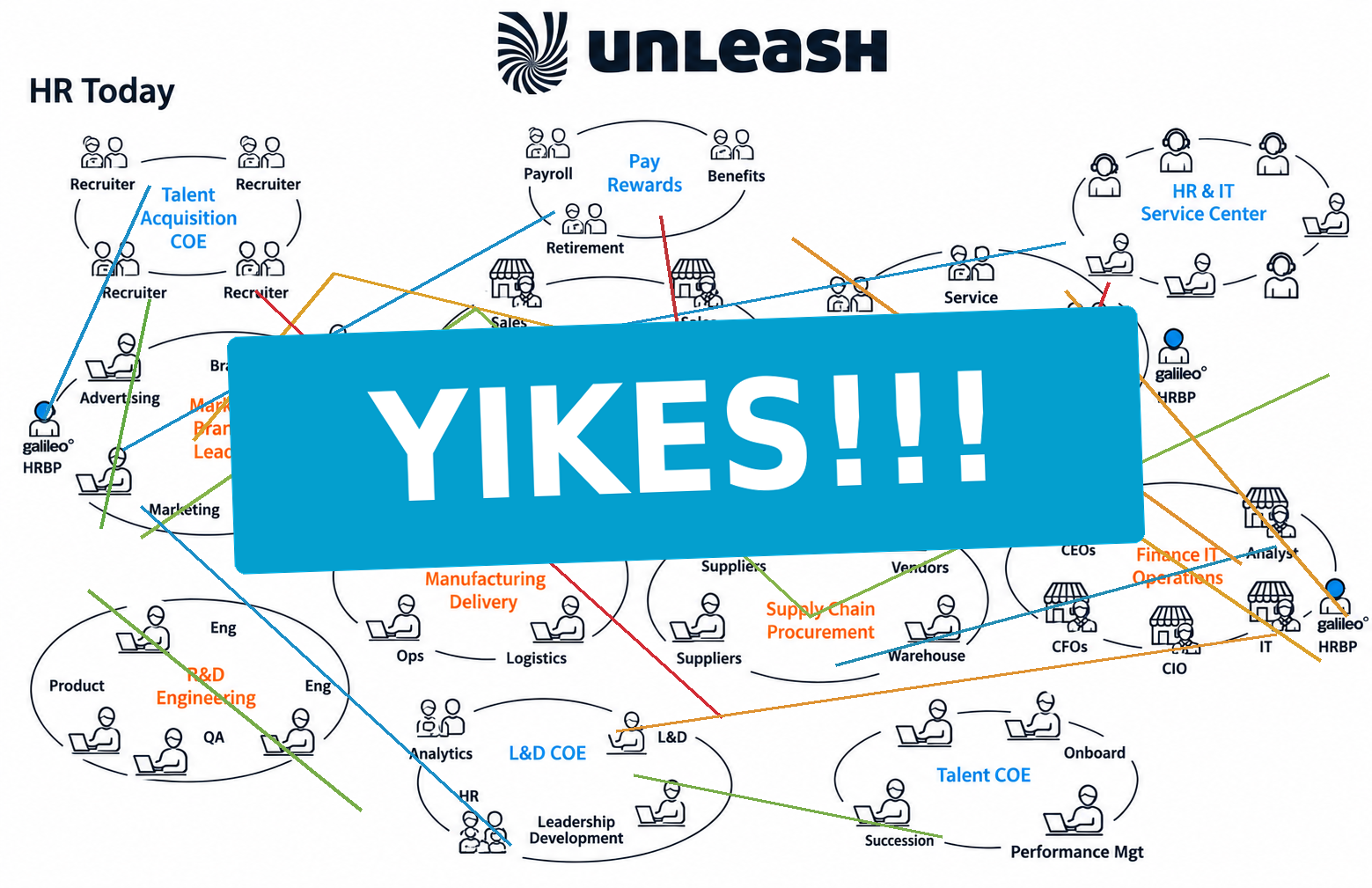
This was one of the most entertaining parts of the talk. Josh walked through how a growing company builds an HR department, almost by accident.
First someone needs to hire people. Then somebody has to pay them. Then they need training, performance management, succession planning, and leadership development. Eventually employees can’t get answers, so we add a service center. Managers want someone who understands their business, so we add HR business partners, who then have to navigate all the specialist teams we’ve created.
Each addition answered a real need, but together they produced an enormous collection of functions and handoffs.
Then came the software. Enterprise systems designed for finance, supply chains, manufacturing, and inventory started treating people as another kind of asset, rather like boxes in a warehouse. Specialist HR platforms followed, and then more products for recruiting, learning, performance, payroll, and everything else.
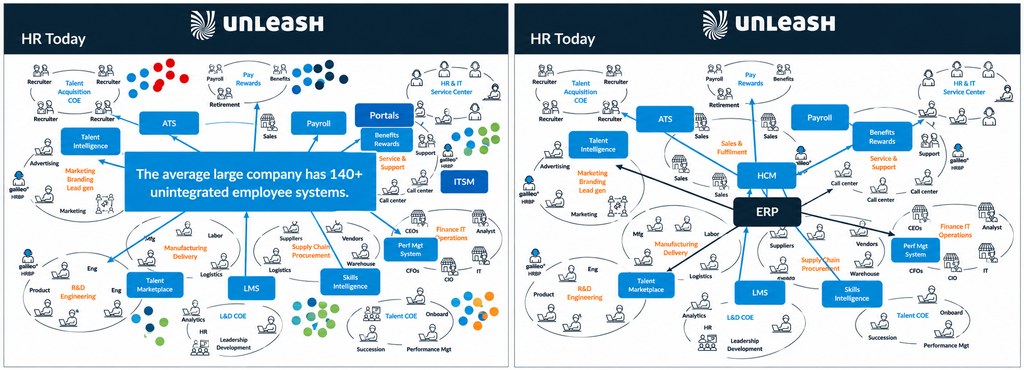
Eventually employees couldn’t find anything, so we built a gigantic portal on top of it all.
Josh said the average large company now has about 140 employee-related systems. Want to make a big workforce decision? You might need a bunch of PhDs just to find and reconcile the data. By the time they’ve finished, the business leader may have given up and made the decision without HR.
The Josh Bersin vision for HR in 2030
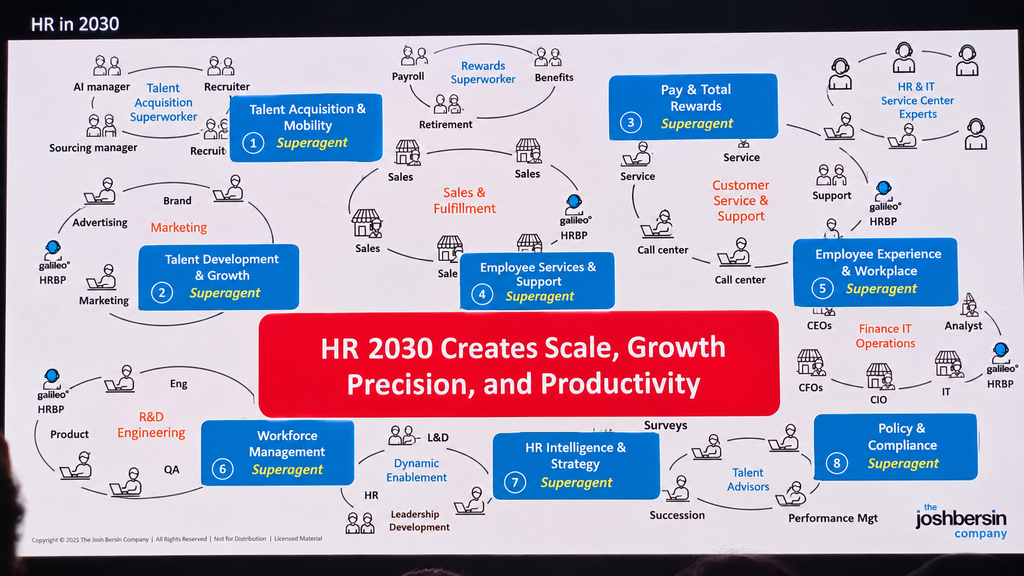
Rather than asking how AI could improve today’s departments, Josh and his Josh Bersin Company team asked what HR would look like if they designed it from scratch for 2030.
Their model connects eight major HR functional areas through larger AI “superagents” and smaller specialized agents. Josh described 161 potential agents in the architecture—not necessarily 161 products to buy, but different activities and decisions that could be supported and connected.
The ambition is what he called dynamic enablement for growth: HR that can identify problems, bring together information, and help the business act, rather than waiting for separate teams to investigate.
It gets more provocative when he talks about personal AI agents. Imagine employees having digital assistants that understand their work, goals, and experiences. Josh suggested that, rather than relying entirely on periodic engagement surveys, an organization’s agents might be able to learn from information employees already share with their own assistants. Employees are talking about their managers and their jobs; they’re just not always telling HR.
That raises serious questions about privacy, consent, and trust. Josh was describing a possible future, not current practice.
Four stages of AI transformation
Josh described a progression that will sound familiar to anyone experimenting with AI:
- Make today’s work easier. Summarize meetings, analyze spreadsheets, write interview guides, and answer questions.
- Save repeatable work as agents. Turn the prompts and automations you use regularly into reusable tools.
- Redesign the process. Stop asking how to automate every step and ask whether those steps are needed at all.
- Connect the agents. Let recruiting, onboarding, performance, and other systems share what they’re learning and improve decisions together.
He compared this to self-driving cars. Parking assistance and cruise control help someone drive, but the real goal is to get the passenger to their destination. Design around that outcome and perhaps you don’t need a steering wheel.
This is also where some roles may disappear. Interview scheduling, for example, can be a job in its own right, but it may no longer need to exist as a separate set of steps in a redesigned recruiting process.
Managing agents? HR already knows a lot about that
Josh’s advice was to manage digital agents much like new employees. Give them a job, goals, boundaries, access to the systems they need—but not every system—and monitor how they’re performing.
“Just think of them like people.” — Josh Bersin
He also pointed out that AI isn’t automatically the cheapest solution. An agent can burn through substantial computing costs, and using an expensive AI model to calculate 2 + 2 makes little sense when ordinary software can do it instantly. We’ll need to manage what agents do, what they cost, and when they should stop.
Then came a lovely example from Josh’s visit to the Ferrari factory. Different models move along the same production line, with specialist teams and equipment handling particular parts of the work. That’s how he imagines effective AI systems: not one giant agent doing everything, but specialized agents working together.
What that looks like in practice
Suppose a competitor in Germany goes out of business and your German operation suddenly has a big opportunity. Today, a manager might request 50 new hires and HR starts recruiting.
In Josh’s future scenario, connected finance and workforce agents could also notice that the New York operation has spare capacity. A skills agent could identify employees who might suit the German roles and help explore options with their managers, rather than automatically hiring 50 people. Recruitment, internal mobility, development, and financial planning become one connected decision.
The technology and workforce-planning implications
Josh doesn’t buy the idea of a “SaaS apocalypse.” He thinks the large HCM vendors may become more powerful because they already hold much of the data agents need. Platforms could shift from storing transactions to actually doing work, while making it easier for organizations to build agents of their own.
And workforce planning gets another dimension. Alongside recruit, retain, reskill, and redesign, Josh proposed a fifth R: robot. Decisions about capacity will increasingly involve people and agents, including their skills, costs, and the work each should do.
Skills frameworks and job architecture may become more useful too, because AI can help break jobs into tasks and identify where work could be reorganized, rather than treating a skills taxonomy as the end goal.
Where to begin
One practical starting point Josh emphasized was talent acquisition. Recruitment includes numerous steps, from defining the role and sourcing candidates to assessments, interviews, offers, and onboarding. There is plenty to improve, and faster, more accurate hiring can help a business generate revenue, not just cut HR costs.
His vision isn’t simply AI bolted onto the HR function we’ve built over decades, but a redesign of how work is organized and decisions get made.
Thank you to Josh Bersin, The Josh Bersin Company, and UNLEASH for a fascinating session. I am sure I have missed bits, but I it should give you a flavour. The diagrams are AI recreations of Josh’s presentation where the photos were a bit too wonky, and this is a recap of the main material I captured, not a complete transcript.
Related Articles
-

Flexible Working Requests Get a Reasonableness Test, and Records Will Carry the Weight
Refusing flexible working requests will need a written, reasoned file from autumn 2027, and the Acas consultation on the code is open until 17 December.
4–7 minutes -

AI is starting to redraw the org chart: four companies changing how work gets done
Within three days, HENNGE launched a company with no dedicated employees, BMW set out plans for 20% leaner management structures, Millennium expanded personalised AI twins and Whitbread described AI as its “third workforce”. Together, they offer a glimpse of what happens when AI moves from being a tool inside a job to becoming part of the organisation itself.
4–7 minutes -

Leaders Say AI Is Saving Time. Workers Are Less Convinced.
Vertage research finds 71% of leaders say AI adoption has increased capacity, against 43% of workers. What HR should ask about the time AI frees up.
2–3 minutes
Most Read
Get it in your inbox
The EMEX weekly newsletter — insight for HR leaders every Thursday.
Advertisement