The Death of the Ping Pong Table: Why Perks Never Solved the Real Problem
Global employee engagement fell to 20% in 2025, the lowest level Gallup has recorded since 2020. That marks two straight years of decline.
Global employee engagement fell to 20% in 2025, the lowest level Gallup has recorded since 2020. That marks two straight years of decline. The cost is massive: $10 trillion in lost productivity, or about 9% of global GDP. Europe is the least engaged region at 12%, and the UK sits even lower at 10%. The Employee Engagement era was supposed to fix this. It did not.
The Engagement Era Started with a Serious Idea
The modern engagement story starts in 1990 with William Kahn. His framework argued that people bring physical, cognitive, and emotional energy into work when three conditions exist: meaningfulness, safety, and availability. Leaders embraced that idea because it gave them a language for discretionary effort. If people felt connected, they would give more.
That shift pushed workplace conversations beyond pay and process. It gave HR a stronger case for purpose, trust, and culture. But the model carried a flaw that became clearer over time. It treated human energy like something organisations could keep drawing on as long as the conditions felt right. In practice, many companies chased engagement scores while expecting people to keep stretching further.
Discretionary effort became the prize. Sustainable effort rarely got the same attention.
Then Perks Took Over the Story
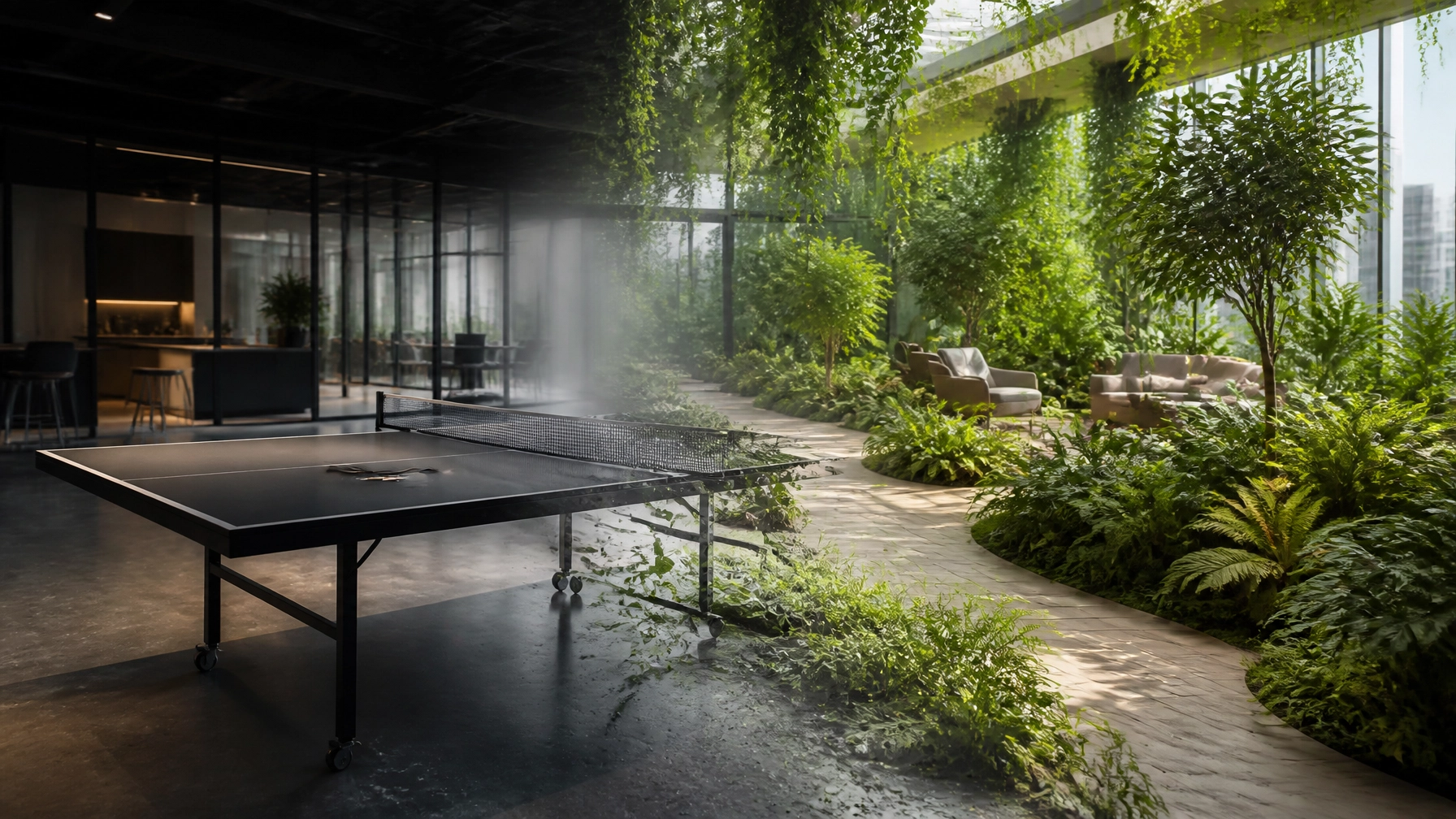
By the late 1990s and 2000s, the focus moved from psychology to design. Companies built employee experience around the office itself: better food, better furniture, better amenities, better branded culture. Google campuses, game rooms, free meals, breakout spaces, and lifestyle perks became the visual language of a modern employer. The ping pong table became the symbol of the era because it captured the promise in one object: work can feel fun, so people will feel engaged.

The problem is that pleasant design never solved structural strain. Gallup’s latest data shows 40% of employees still experienced daily stress in 2025. ManpowerGroup’s Global Talent Barometer found 63% of workers describe current burnout, while 49% report high daily workplace stress. Those numbers sit right next to years of investment in employee experience, office amenities, and culture branding. The office looked better. Work did not necessarily feel better.

That is why the ping pong table now feels less like a benefit and more like a relic. It stands for a period when many organisations tried to design around the problem instead of fixing the system causing it.
Change Fatigue Exposed the Limits of Perk-Led Culture
The gap becomes even sharper when you look at how work has changed. Employees are tired of adapting without recovery, says recent UK research. Deloitte’s 2026 UK data found that 76% of workers say their wellbeing has suffered because of change fatigue. At the same time, only 18% of UK organisations say they manage change effectively.
A beautiful office cannot fix that. A free lunch does not reduce cognitive overload. A games room does not make repeated restructures, shifting priorities, poor communication, and constant transformation easier to carry.
This is where many employee experience strategies stalled. They improved moments around work while leaving the work itself untouched.
The Credibility Gap Got Harder to Ignore
The problem is not only that perks failed to solve burnout. It is also that leaders often thought they were doing far more than employees actually felt. Deloitte’s 2024 human sustainability research found that 82% of leaders say they are advancing human sustainability. Only 56% of workers agree.
That is quite a big gap. Leaders may believe they are investing in people because they offer wellbeing programmes, learning budgets, and polished office environments. Employees judge the experience differently. They look at workload, energy, stress, career mobility, and whether work leaves them healthier or more depleted than before.
That is the real failure of the ping pong table era. It trained organisations to confuse visible perks with lived experience.
Human Sustainability Changes the Standard
The next phase is more demanding. Deloitte frames human sustainability as an organisation’s ability to create lasting value for people as human beings. That means better health, stronger skills, and deeper belonging.
This is a structural shift in what good work looks like. The question is no longer whether employees enjoy the office or feel momentarily engaged. The question is whether work improves people over time or drains them.
Workers already understand the difference. Deloitte found that 70% say stronger human sustainability would improve their engagement and job satisfaction. Another 60% said they would even accept a pay cut for it. That is not a vote for better perks. It is a signal that people want healthier systems.
What Actually Changes
Human sustainability forces leaders to move from surface-level experience design to fundamentals.
1. Redesign work to reduce cognitive strain
Fix workload design, meeting load, digital noise, and recovery time. Stop treating overload as a resilience issue. Treat it as a design flaw. Leaders can explore rehabilitation strategies for high achievers to better understand the nuances of cognitive restoration.
2. Invest in skills people can carry with them
Build portable skills, not only role-specific capability. Development should strengthen long-term employability, not only this quarter’s business plan.

3. Aim for net-positive health outcomes
Work should leave people healthier, not just productive. That means better mental health support, realistic expectations, recovery-friendly norms, and leadership habits that do not reward exhaustion.
4. Communicate honestly during change
Employees can handle hard truths better than polished spin. Real sustainability needs internal communications strategy that explains what is changing, why it matters, what support exists, and what leaders will stop doing.

The death of the ping pong table does not mean offices have to be soulless and without perks. But we are entering a new era now of human sustainability and with people more overloaded than ever, protecting mental health, capacity and over-exertion is the new challenge for employee experience teams.
Related Articles
-

Leaders Say AI Is Saving Time. Workers Are Less Convinced.
Vertage research finds 71% of leaders say AI adoption has increased capacity, against 43% of workers. What HR should ask about the time AI frees up.
2–3 minutes -
AI and Labour Relations: Employers Expect Organising, Few Feel Ready
Only 9% of employers feel very prepared for AI and labour relations, yet 87% expect unions to use AI fears to organise, a Littler survey finds.
3–5 minutes -

Forget the Four-Day Week. What Happens When AI Does a Third of Your Job?
At Employee Benefits Live 2026, conversations about AI, fair pay, childcare and employee wellbeing led me to a question for HR and reward leaders: if AI frees up 12 hours of someone’s working week, does that time belong to the employer or the employee?
5–7 minutes
Most Read
Get it in your inbox
The EMEX weekly newsletter — insight for HR leaders every Thursday.
Advertisement