
Hiring for potential: what H2FLY looks for when there is no blueprint
H2FLY is hiring engineers to solve problems that, in some cases, nobody has solved before. Its Head of People and Organisation, Christina Fretz, explains why the company looks beyond keywords—and why rejecting AI screening does not mean relying on gut feel. What does the perfect CV look like when you are hiring people to do…
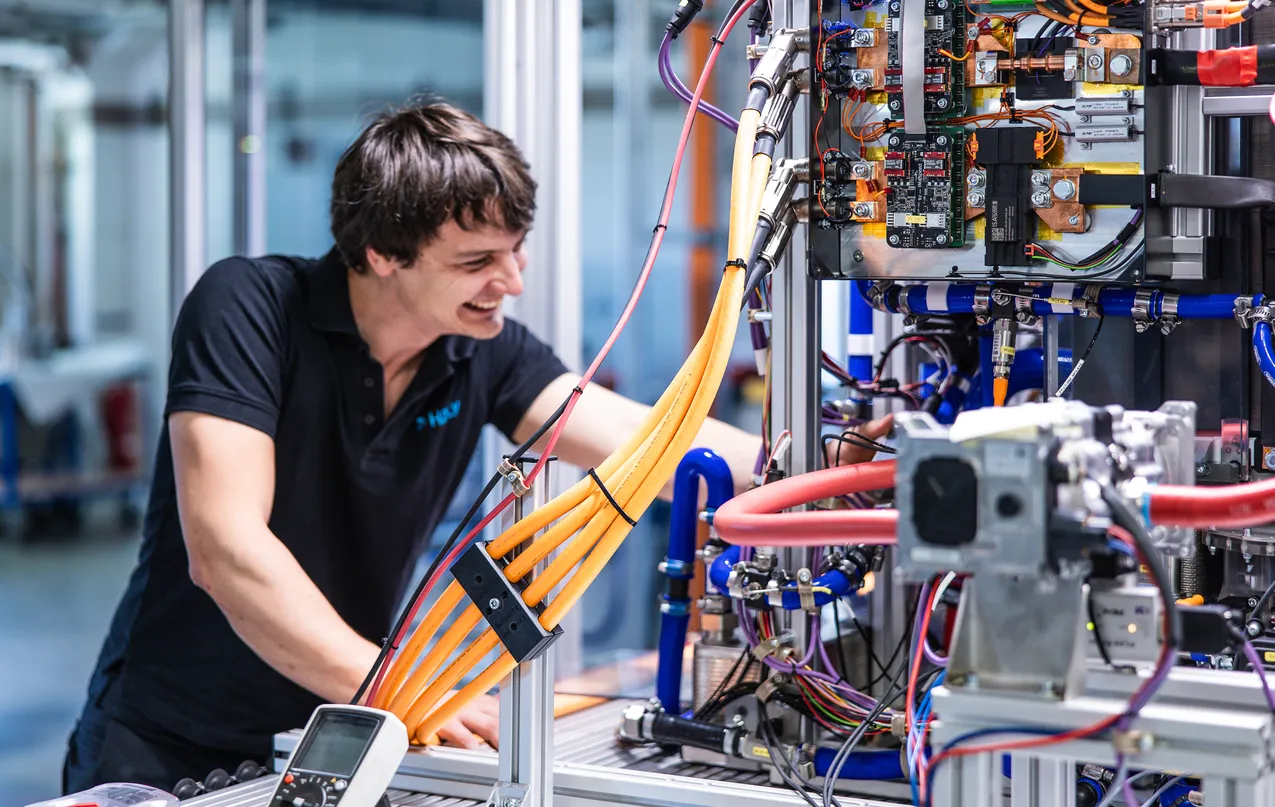
H2FLY is hiring engineers to solve problems that, in some cases, nobody has solved before. Its Head of People and Organisation, Christina Fretz, explains why the company looks beyond keywords—and why rejecting AI screening does not mean relying on gut feel.
What does the perfect CV look like when you are hiring people to do work that, in some cases, nobody has done before?
At H2FLY, that is not a hypothetical question. The Stuttgart-based company is developing hydrogen-electric propulsion systems for aviation. In 2023, it completed the world’s first piloted flight of an electric aircraft powered by liquid hydrogen. Now it is working to take the technology from demonstration to commercially viable aviation
There is no established career path for some of that work. No perfectly matched previous employer. Sometimes, not even a ready-made job description based on how somebody else has done the role. For a company building tomorrow’s aircraft, a match on previous job titles was never going to work. They needed a different approach.
Christina Fretz came to H2FLY’s HR Leadership from learning and development, having previously built leadership programmes and digital learning at Porsche. That background still shapes what she looks for in a candidate.
“Skills can be developed, but curiosity is much harder to teach,” she told me.
The CV is a record, not a forecast
H2FLY operates in a field where the technology, jobs and regulation are evolving together.
“We operate in an industry that is changing quickly and solving problems that often haven’t been solved before,” Christina said. “So we need people who are willing to learn, challenge assumptions and evolve alongside the technology.”
The company looks for curiosity, resilience, ownership and structured thinking. None is easily captured by a keyword match.
“A CV may not contain the precise terminology an automated system is looking for, while the person behind it could have highly relevant transferable skills, experience from another industry or exactly the kind of adaptability we need.”
H2FLY has therefore chosen not to introduce automated AI screening of candidates.
“If a screening tool saves time but filters out people with the potential to succeed in your organisation, it isn’t making recruitment more efficient.”
That does not make previous experience irrelevant. It changes the question recruiters ask of it. Instead of looking only for proof that somebody has already held the same role, H2FLY looks at how they approach unfamiliar problems, collaborate, recover when something goes wrong and adapt when circumstances change.
Careers rarely move in straight lines
H2FLY has seen employees move from Project Management into Component Engineering Lead roles as their technical interests and capabilities developed. Others have moved from Electrical & Controls Engineering into Modelling & Simulation when their analytical strengths and ambitions pointed in that direction.
“Careers rarely develop in perfectly straight lines, and I don’t think recruitment or talent development should assume that they will.”
Those moves make the argument for potential tangible. A job title can describe where somebody has been without showing where they could go next.
It also means recruiters and hiring managers need to recognise capability that arrives in an unfamiliar package. The candidate from another industry may understand the problem differently. The career switcher may bring useful skills without the expected vocabulary. The person with the neatest progression on paper may not be the person most comfortable working without a blueprint.
Human judgement cannot mean gut feel
Removing an algorithm does not automatically make recruitment fairer. An unstructured interview can exclude strong candidates just as easily as an automated screen.
“Human judgement should never mean simply relying on gut feeling,” Christina said.
H2FLY uses defined role requirements, structured interviews and multiple perspectives, with candidates assessed against consistent criteria.
“The goal is to combine a rigorous process with enough human interaction to understand the person behind the application.”
That is the harder version of human hiring. It asks interviewers to look beyond a conventional career path without replacing evidence with instinct. Judgement still has to be explainable. Questions still need a purpose. More than one person needs to test the conclusion.
AI can draft the job ad. It does not choose the candidate
Christina is not anti-AI. H2FLY uses it to support first drafts of job advertisements, which people review and tailor. Automation also handles scheduling and administrative workflows.
“Used well, those tools free up time that we can spend speaking to candidates and working closely with hiring managers.”
Her line is clear:
“Technology should help people make better hiring decisions, rather than make those decisions for them.”
The human approach has not condemned H2FLY to a glacial recruitment process. Christina reports an average time-to-offer of 49 days and time-to-hire of 57 days. By July 2026, around 80% of its current hiring cohort had been filled.
At a much larger organisation, manually reviewing or sourcing every candidate may not be realistic. Christina sees room to automate scheduling, routine communication, search support, talent pooling and drafting. She becomes more cautious when technology starts evaluating motivation, learning agility, transferable skills or future contribution.
Automating the administration could create more time for the part that needs to remain human.
Potential still needs somewhere to go
Hiring for potential only works if people have room to develop after they arrive.
At H2FLY, “having an impact” emerged as the highest-rated positive dimension of working at the company. Christina attributes that partly to the line of sight people have between their own work and the wider mission.
“A compelling mission isn’t enough on its own. People also need to understand their individual role in delivering it.”
H2FLY uses OKRs to connect company priorities, team responsibilities and individual goals. Development is shaped around individual strengths and ambitions rather than a standard progression ladder—the same logic that allows somebody to move between disciplines when their capability points in a new direction.
Hiring for what comes next
Christina expects the balance between experience and potential to shift over the next decade.
“One of the biggest shifts will be from hiring predominantly for past experience to hiring much more deliberately for future potential.”
At H2FLY, more than 80% of the components required for its hydrogen-electric aviation work are engineered internally. Its teams are developing technology while regulation evolves around them.
“Hiring somebody solely because their CV perfectly matches yesterday’s job description doesn’t make sense.”
That challenge will not remain confined to frontier engineering. As technology reshapes jobs, more employers will need people who can transfer what they know, learn quickly and solve problems their previous title never prepared them for.
Related Articles
-

London Weighting and Location-Based Pay: Why Geography Raises Some Salaries and Discounts Others
London weighting pays a premium for working in the capital. But as other cities become more expensive and work goes global, does location-based pay still make sense?
4–6 minutes -

What Happens When Recruitment Stops Parsing CVs and Starts Asking AI?
The PDF CV was built for an era when recruitment software needed one predictable file. Large language models can understand a career across several sources, which means the document is losing its claim to be the centre of hiring. By Javier Martínez, founder and CEO of Self A PDF is excellent at preserving the layout…
4–5 minutes -

Europe’s Women in Tech Pipeline Problem Starts Years Before Recruitment
New Eurostat data shows the women in tech pipeline is decided at degree choice, not at the job ad. Here’s what HR leaders should look at instead.
3–5 minutes
Most Read
Get it in your inbox
The EMEX weekly newsletter — insight for HR leaders every Thursday.
Advertisement