Everyone is talking about AI. Here are five things I heard at James Poulter’s book launch that stuck with me
On a Thursday evening in a small independent bookshop in Shoreditch, I went to hear James Poulter launch AI at Work. There was plenty about what AI can do. But the most interesting questions were about what happens to us. Everyone is talking about AI. Most of us are using it, too. Yet when James Poulter asked…
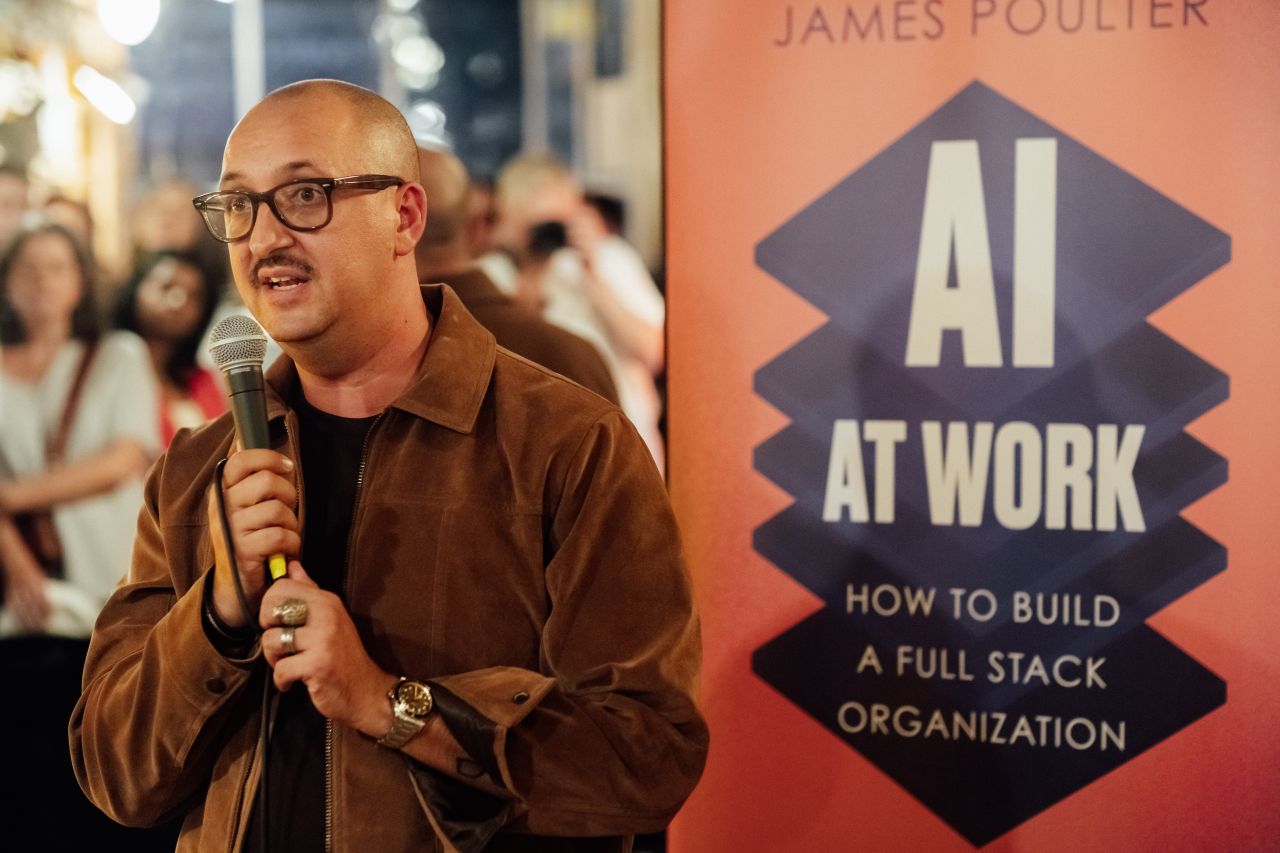
On a Thursday evening in a small independent bookshop in Shoreditch, I went to hear James Poulter launch AI at Work. There was plenty about what AI can do. But the most interesting questions were about what happens to us.
Everyone is talking about AI. Most of us are using it, too. Yet when James Poulter asked the room how many people felt good about that use, far fewer hands went up.
That is a strange feature of this particular technological revolution. We are using the tools before we have worked out how we feel about them, what good use looks like or what we want them to do to our working lives.
James has spent much of his career arriving early to technologies the rest of us later start talking about. There is a slightly unlikely route to becoming an AI expert that begins with a degree in radio production, but James took it. He was an early adopter of the humble podcast, went on to become Head of Emerging Platforms at LEGO, then founded voice technology company Vixen Labs, which was acquired by House 337 in 2023. Today he runs AI transformation company ThreePoint Labs.
His new book, AI at Work: How to Build a Full Stack Organization, is practical. It looks at how individuals, teams and organisations can build real capability with AI, rather than scattering a few tools around and declaring themselves transformed. But at its London launch, James kept returning to something deeper: the choices we make now about what work is for, how people develop and where human value sits.
Here are five ideas I came away thinking about.
1. This change is not just big. It is brutally fast
Comparisons between AI and the Industrial Revolution are everywhere. Humanity lived through that transformation, the argument goes, and we will adapt to this one too.
James does not entirely disagree. He just thinks the timescale matters.
“The Industrial Revolution took about 135 to 150 years,” he told the room. “That’s a lot of time for people to adjust. We’ve had ChatGPT for, what, 48 months?”
We do not have generations to watch this change unfold from a safe distance. We are both the people living through it and the people making choices that will shape what is handed to our children.
That could sound bleak, but James’s argument is not that the future is settled and terrible things are coming for us. It is almost the opposite.
“We talk about AI agents and agency,” he said. “We are the ones that have agency.”
There are powerful commercial forces shaping how AI develops, of course. But organisations still choose what to automate, what to protect, what to reward and what kind of working experience they want to create. Speed makes those choices more urgent. It does not make them disappear.
2. If AI removes the junior work, how do we create the senior people?
This was the idea I could not stop thinking about.
Most established professionals can remember spending their early working years doing tasks that were repetitive, mechanical or simply dull. Much of that work can now be done faster and more cheaply by AI. On a spreadsheet, employing a junior person to do it may soon make little economic sense.
But perhaps we have misunderstood what the boring work was doing.
While people were formatting presentations, drafting first versions, taking notes and carrying out basic research, they were also watching experienced colleagues. They were hearing how a difficult client conversation was handled. They were learning when a technically correct answer was not the right answer. They were absorbing judgement, confidence, professional standards and the unwritten rules of working life.
“The skills are in the AIs,” James said. “But the character formation, the shaping of people, is the thing that happens when we go to work every day.”
His conclusion is uncomfortable. If we want capable people to be available in five or ten years, organisations may have to keep giving them work even when AI could complete the task more efficiently. Not because people need to master every mechanical skill, but because becoming a professional has never been only about completing the task.
This gives HR, L&D and business leaders a much bigger question than how many graduate roles AI might replace:
If we automate the bottom rung of the career ladder, what are people supposed to stand on to reach the next one?
The answer could involve better apprenticeships, deliberate observation, mentoring, simulations and earlier exposure to real decisions. Whatever replaces the old route, it will need to be designed. Character formation is too important to leave behind as an accidental casualty of efficiency.
3. The great AI skill may be explaining what you actually want
James has had Excel on his desktop for two decades. He still does not really know how to use it and, to his evident relief, no longer believes he will have to learn.
As AI turns more software into a conversational interface, we may need less knowledge of which button to press. But that does not remove the need for skill. It shifts it onto the very basic human skill of explaining yourself very clearly.
We need to be able to describe the outcome we want, provide useful context, interrogate what comes back and recognise whether it is any good. In other words, we need to become better at articulating what is currently sitting, half-formed, inside our heads.
“When everything that was once software is now a conversation,” James said, “we all have to become better conversationalists.”
That is not merely prompt engineering. It is briefing, delegation, reasoning and communication. It is knowing what good looks like before asking a machine to produce it.
James distilled the question rather neatly: “What does AI want? AI doesn’t want anything. What do you want?”
AI may expose a workplace problem we already had. We often struggle to explain clearly what we mean, whether we are speaking to a machine, an employee or each other. If you think about it, AI may even make us better communicators to our friends, families, partners as well as colleagues, which won’t be a bad thing for society at all.
4. Teach people AI, but do not let them skip becoming capable humans
James is not calling for an analogue rebellion. He believes young people need to learn how to use AI, manage context, work with agents and understand the power of the tools in front of them.
But giving someone the easiest route before they have developed the underlying capability creates another risk. If a young person can produce an essay, an analysis or an idea without first learning to write, reason or create, what will help them judge the result?
His advice was to make young people do the “hard yards” while they are still forming those capabilities. Critical thinking, creativity, expression and the ability to hold a good conversation do not become less valuable when AI can execute more of the work. They become the basis on which good AI use depends.
This is not only a question for parents, schools or universities. Employers need to ask whether graduate programmes and entry-level roles still develop capability, or whether AI has simply enabled juniors to produce more polished work without understanding how they got there.
Teaching AI skills is necessary. Creating people who know what to do with those skills is the harder job.
5. What if AI’s greatest productivity gain is not more productivity?
For all the large questions, James is also pleasingly practical.
His challenge to the room was to open the Downloads folder on our computers and look at the chaos inside. Ask AI to organise it, he suggested. Get it to read every screenshot on the desktop and replace “Screenshot 2_2” with a filename that tells you what the image contains. Then consider how the same approach could remove friction across the rest of your digital working life.
The book takes that practicality much further, offering frameworks for moving from isolated experiments to AI capability across individuals, teams and the wider organisation.
But the Downloads folder led James to a more interesting definition of the prize. If AI deals with enough digital clutter and low-value administration, it could give us time for the things that are important but never urgent enough to reach the top of the list: thinking, coaching, relationships, learning, creativity and strategy.
What if the goal is not to squeeze another 20% of output from already stretched people? What if it is to give them enough space to do the parts of work that humans repeatedly say matter, then repeatedly fail to find time for?
Of course, that only works if organisations do not immediately fill every reclaimed hour with more work.
We still get to choose
The thread running through all five ideas is agency. AI is changing work at extraordinary speed, but it is not a weather system totally outside our control. Leaders are making choices about how it enters organisations, whose work it replaces, how future talent develops and who benefits from the time it saves.
AI at Work: How to Build a Full Stack Organization by James Poulter is published by Bloomsbury and available now in hardback, ebook and audiobook. James narrates the audiobook himself, which feels pleasingly appropriate for someone whose journey into technology began with radio.
Related Articles
-

Extra annual leave tops UK workers’ benefits wish list, SD Worx finds
Almost half of UK employees surveyed want additional days off as a workplace benefit, while only 17% currently receive them, according to new SD Worx research. Extra annual leave has emerged as the most wanted workplace benefit among UK employees surveyed by SD Worx, highlighting a sizeable gap between what workers value and what employers…
2–3 minutes -

The Questions That Help Managers Coach Themselves
A story about how insightful questions can turn everyday working experience into a source of self-coaching Shane was an analyst. He solved problems for a living and was good at it. When a management role came up, he seemed a natural fit. But managing people was a different kind of problem. There were frustrations and…
5–7 minutes -

Why business leaders must rebuild the first rung of the career ladder
Much has been written about whether AI will replace graduate jobs. It’s an important debate that deserves serious attention but from where I sit as a CEO, I believe we’re at risk of focusing on the symptom rather than the cause. The challenge facing young people entering the workforce began long before generative AI arrived. Over…
4–5 minutes
Most Read
Get it in your inbox
The EMEX weekly newsletter — insight for HR leaders every Thursday.
Advertisement